
















What Is a Blind Count and Why It Reduces Variance
A blind count is an inventory count where the counter does not see the expected system quantity before recording what is physically on the shelf. Hiding the book balance removes confirmation bias, so real variances show up instead of getting rounded toward the system number. Use blind counts for A-items, high-value SKUs, audit samples, and any recount that will drive an inventory adjustment.
A blind count is an inventory count where the counter records what is physically on the shelf without seeing the expected system quantity first. The book balance stays hidden until after the physical count is submitted, then the system compares the two numbers. That single change removes confirmation bias, so real variances show up instead of getting quietly rounded toward whatever the WMS already believed.
A blind count inventory method means counting location and SKU with the expected quantity hidden, then reconciling the physical result against the system after the fact.
If your cycle counts keep "confirming" the system and your pickers still hit empty bins, you probably do not have a counting problem. You have a bias problem. Blind counting is how you fix it.
Why do open counts hide real variance?
An open count (sometimes called a directed count) shows the counter the expected quantity on the count sheet or scanner screen. That sounds helpful. It is usually the opposite.
People anchor to numbers. If the screen says 96 and the shelf looks like about 92, a tired counter will recount until they can justify 96, or they will mark 96 and move on. The variance never enters the system. Your accuracy report looks clean. Your customers still get shorted.
That is confirmation bias, not laziness. It shows up on high-velocity pick faces, returns cages, and anywhere the same SKU sits in more than one bin. The U.S. Government Accountability Office (GAO) has long listed blind counts among the controls used by leading inventory operations for exactly this reason: counters get part number, description, and location, but not the on-hand balance, so the physical result can actually challenge the record.
Open counts still have a place for low-risk C-items when you are racing through a large zone and a small miss will not move the P&L. For A-items, high-dollar SKUs, shrink-sensitive categories, and any count that will drive an adjustment, hide the book quantity.
How does a blind count actually work?
The mechanics are simple. The discipline around them is what matters.
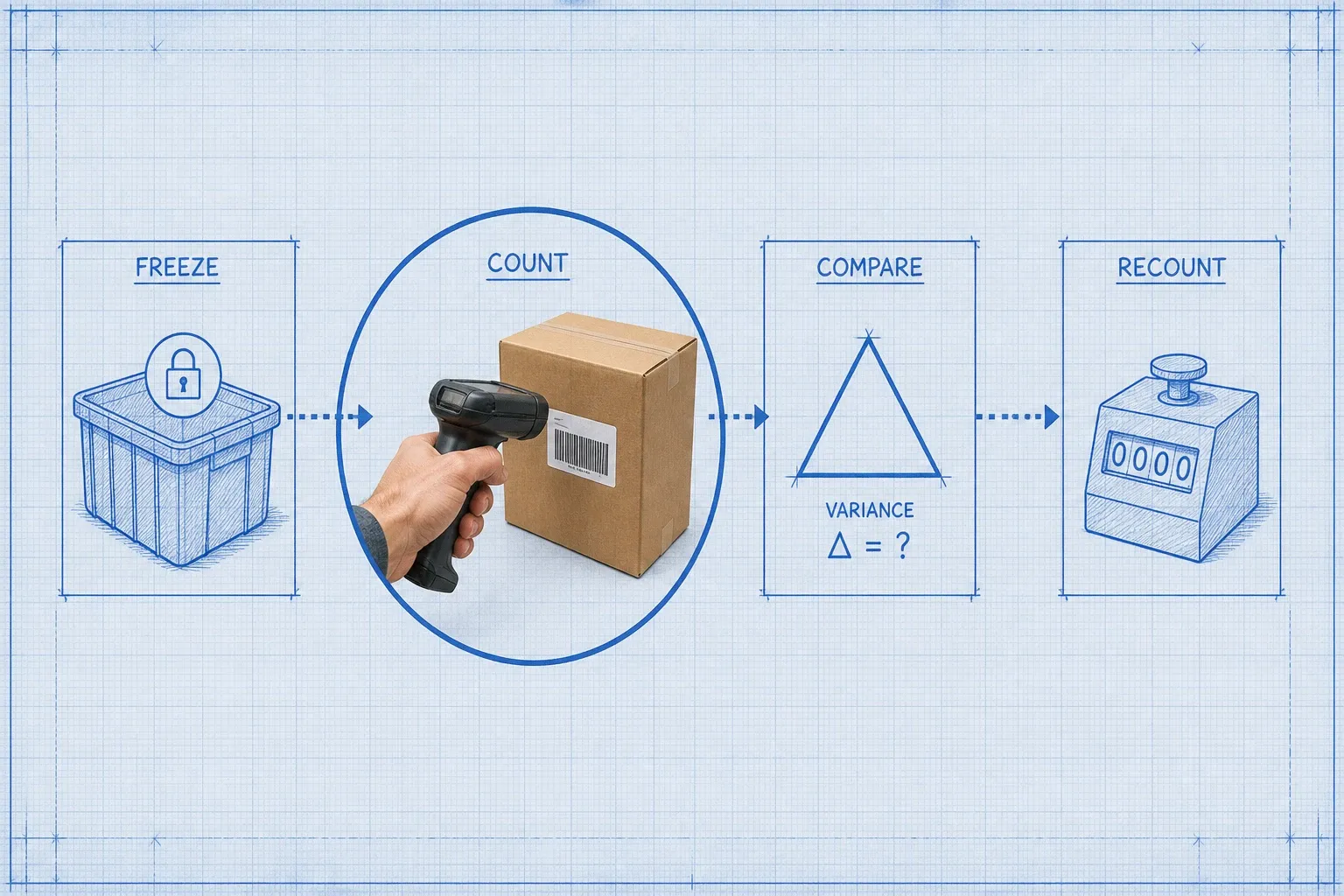
1. Freeze the count zone
Block picks and putaways for the bins you are about to count. If product moves while someone is counting, you invent variance that never existed. A short soft lock in your WMS is enough. You do not need to shut the whole warehouse down. That is the whole point of cycle counting versus a wall-to-wall physical.
2. Snapshot the system quantity
Capture the book balance at the freeze moment. That number stays with the supervisor or the system. The counter never sees it on the first pass.
3. Assign location and item only
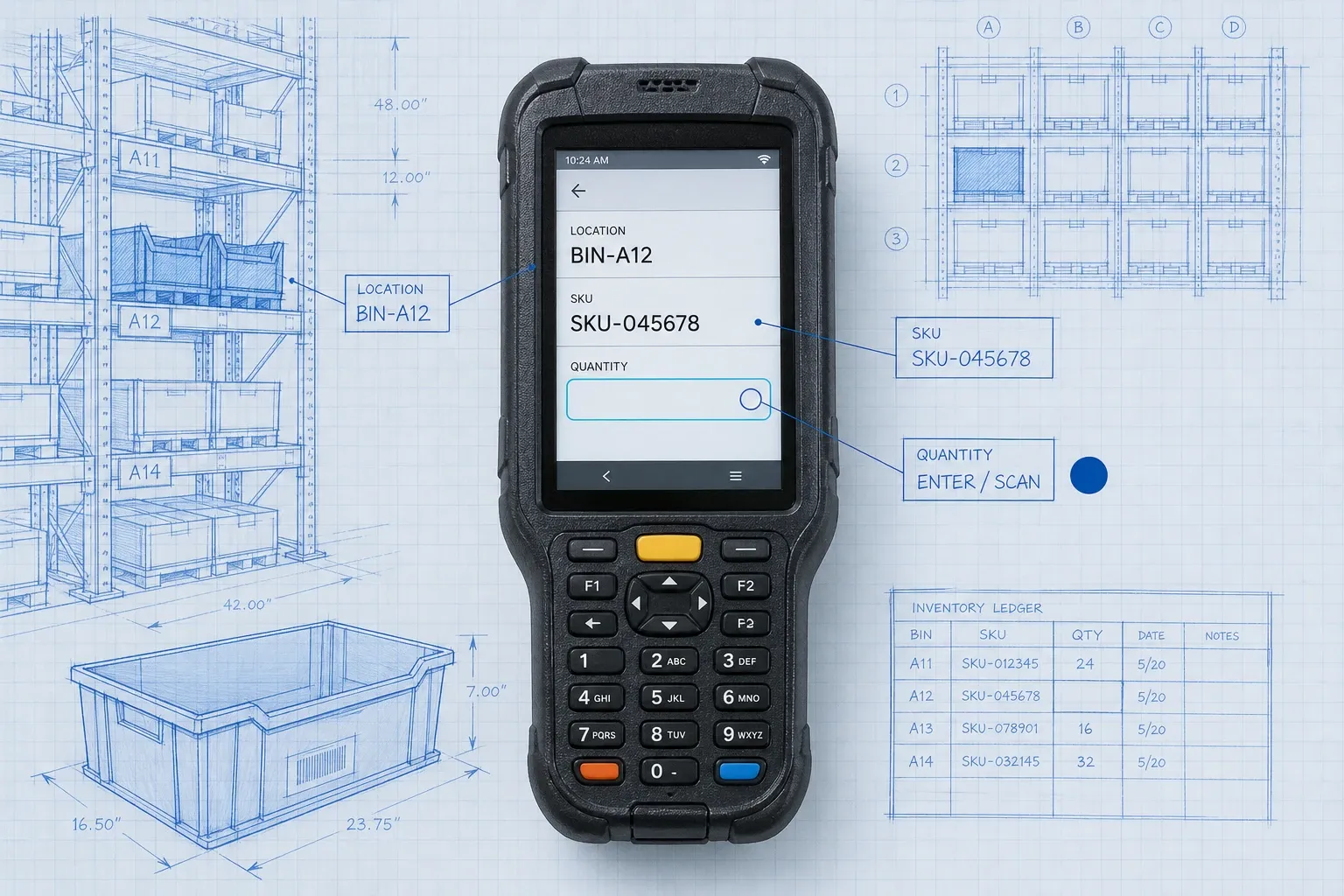
The scanner or count sheet shows bin ID, SKU, and maybe a description or barcode. No expected quantity. No "should be 48."
4. Count what is there
The counter scans or touches every unit in scope, records the physical quantity, and submits. If the bin is empty, they record zero. Empty is a real answer, not a skip.
5. Compare, then recount
The system (or a second person) compares physical vs book. Variances above your threshold go to an independent recount by someone who also does not see the first count or the book balance. Two people agreeing on a wrong number is still wrong. Two independent blind results that match each other and disagree with the system are a strong signal.
6. Investigate before you adjust
Check open transactions, misbins, overflow locations, unposted receipts, and short picks before you write the inventory down or up. Then post the adjustment with a reason code and an owner for the root cause. Adjusting without investigating is how the same bin fails again next Tuesday.
Tools like BinLogic WMS keep the expected quantity off the handheld during the count, soft-lock the bin, and store the recount trail so you are not managing this on a clipboard and a shared spreadsheet.
Why does blind counting reduce variance over time?
Blind counting does not invent accuracy on day one. It changes what your data is allowed to tell you.
When counters can see the expected quantity, your variance report understates the problem. You "fix" fewer misses because fewer misses get recorded. Accuracy looks stable. Fill rate does not. Blind counts reverse that. Detection goes up first. Then, if you actually investigate root causes, true variance falls.
That sequence matters. Operations that treat a spike in detected variance as a failure often switch back to open counts and congratulate themselves on cleaner reports. They did not get more accurate. They got better at hiding the miss.
Industry context makes the stakes clear. According to the 2025 Warehouse/DC Operations Survey from Peerless Research Group for Modern Materials Handling, 76% of distribution centers now track inventory accuracy as a management metric, up from 70% the year before. More teams are watching the number. Fewer of them trust how it was produced.
Separately, CAPS Research data discussed by the Institute for Supply Management has put average inventory accuracy near 91%, with roughly 95% described as world-class within that benchmark set. Getting from "average" to "world-class" is rarely a new barcode gun. It is usually cleaner receiving, tighter location control, and count methods that do not let the system grade its own homework.
Blind counting is the control that keeps your accuracy KPI honest while you climb that curve. Pair it with ABC inventory classification so A-items get counted often enough that bias does not have weeks to compound.
Blind count vs open count: which should you use?
Situation | Prefer blind | Prefer open |
|---|---|---|
A-items / high revenue SKUs | Yes | No |
High-dollar or theft-sensitive product | Yes | No |
Audit sample or financial cutover | Yes | No |
Repeated variance locations | Yes | No |
Low-value C-items, speed priority | Optional | Acceptable |
Training new counters on a quiet zone | Start blind | Review together after |
A practical rule for mid-market warehouses: default to blind. Make open counting the exception you document, not the habit you inherit from a legacy ERP screen.
Also separate the first count from the recount. Even if your first pass is open for a low-risk SKU, any variance that crosses your threshold should get a blind recount by a different person. That single policy catches most of the bias without slowing every C-item walk.
What causes variance that blind counts finally reveal?
Once the bias is gone, the same root causes show up again and again:
- Receiving and putaway misses. Product accepted against the wrong PO line, or put into a neighbor bin.
- Short picks and silent substitutions. Picker grabs from an overflow location and never updates the primary face.
- Unlogged damage or returns. Units leave sellable inventory without a transaction.
- Unit-of-measure confusion. Cases counted as eaches, or inner packs treated as master cartons.
- Phantom inventory from failed soft locks. Someone picked during the count window and the freeze was incomplete.
Blind counts surface these. They do not fix them. Your weekly 15-minute variance review does. Track reason codes. Rank the top three causes. Assign an owner. That feedback loop is how warehouses move from "we count a lot" to 99% inventory accuracy without a shutdown.
How often should blind counts run?
Frequency belongs to your ABC schedule, not to a calendar slogan.
- A-items: weekly or more often on the fastest movers
- B-items: every two to four weeks
- C-items: monthly or quarterly, with blind still preferred for anything that has failed before
If you are still deciding cadence, start with how often you should count warehouse inventory and layer blind counting onto the high-impact slice first. You do not need to convert the entire building overnight. Convert A-items this week. Expand once the recount queue is under control.
Common mistakes that kill blind-count programs
Showing the quantity "just for reference." If it is on the screen, it is an anchor. Hide it.
Letting the same person recount their own variance. Independent means a second counter, period.
Adjusting the same day without checking open transactions. You will write over a receipt that was about to post and create a new miss.
Celebrating zero variances. Persistent zero on a busy pick face is a red flag, not a trophy. Real operations produce some noise. Total silence usually means the count was not blind, or movement was not frozen.
Running blind on paper with no lock. Paper can work for a pilot. At volume, a WMS that hides quantity and locks the bin is what keeps the method honest when the dock is busy.
How do you roll blind counts out without slowing the floor?
Start narrow.
- Pick one zone or one ABC tier (usually A-items).
- Train the team on why the quantity is hidden. Frame it as better data, not distrust.
- Set clear recount thresholds (for example, more than 2 units or 3%, plus any dollar threshold you care about).
- Close A-item variances the same day.
- Review reason codes every week for 15 minutes.
- Expand to B-items once first-count quality is stable.
Measure two things, not one. Track inventory accuracy (locations that match within tolerance) and first-count agreement rate (how often the first blind count survives the recount). If first-count agreement is weak, you have a training or freeze problem. If first-count agreement is strong but accuracy is flat, you are counting well and still not fixing root causes.
Soft close: make the count method match the accuracy goal
Blind counting is a control, not a slogan. Hide the expected quantity, freeze the bin, recount with a second person, and investigate before you adjust. Do that on the SKUs that actually move your revenue, and your variance number stops lying to you.
If you want the count workflow baked into daily ops instead of a weekend fire drill, BinLogic WMS is built for mid-market teams that need blind cycle counts, bin locks, and a clean audit trail without standing up an enterprise IT project. Start with your A-items. Let the data get honest. Then fix what the variances keep pointing at.
Related reading
Frequently asked questions
What is a blind count in inventory?
A blind count is a physical inventory count where the counter sees the location and item, but not the expected system quantity. They record what is actually on the shelf, and the system compares that number to the book balance afterward. That hides confirmation bias and produces variance data you can trust.
Why does a blind count reduce inventory variance?
It does not magically create fewer errors. It reduces hidden variance by stopping counters from unconsciously matching the system quantity. When people can see "system says 240," they tend to round a true 237 toward 240. Blind counts surface that gap so you can investigate and fix the process that caused it.
When should you use blind counts vs open counts?
Use blind counts for A-items, high-dollar SKUs, locations with repeated variances, audit samples, and any count that can trigger a financial adjustment. Open (directed) counts can be fine for low-risk C-items when speed matters more than forensic precision. Most mid-market warehouses default to blind for anything that affects revenue or customer fill rate.
How do you run a blind cycle count step by step?
Freeze movement in the count zone, snapshot the system quantity, assign the location without showing that quantity, count and submit the physical result, compare to the book balance, recount variances with a second person, investigate open transactions, then post an adjustment with a reason code. Log the root cause so the same miss does not return next week.
Do you need a WMS to do blind counts?
You can run paper blind counts, but a WMS makes them practical at scale. The system hides the expected quantity on the scanner, locks the bin during the count, and stores the audit trail automatically. Without that, blind counting slows down and the paper trail gets messy.
Plan the route. We deliver the rest.
See how Binlogic powers last-mile logistics — routing, tracking, and the platform that turns the plan into the package on the doorstep.
Book a callback