
















How to Achieve 99% Inventory Accuracy Without Shutting Down
You can reach 99% inventory accuracy without shutting the warehouse by replacing the annual physical with continuous cycle counting, ABC prioritization, scan verification at every touch, and weekly root-cause fixes. The goal is not a perfect snapshot once a year. It is a system that catches and corrects errors while orders keep moving.
You can hit 99% inventory accuracy without shutting your warehouse by running continuous cycle counts, prioritizing A items, verifying every scan touch, and fixing root causes weekly instead of freezing the building for an annual physical.
99% inventory accuracy warehouse performance means nearly every counted SKU and location matches the system record while receiving, picking, and shipping keep moving.
That gap between "good enough" and world-class is smaller than it looks on a dashboard and larger than it feels on the floor. According to CAPS Research (summarized by the Institute for Supply Management in 2024), average inventory accuracy across surveyed organizations sat at about 83%, and only about 69% of companies tracked the KPI at all. Nucleus Research found that organizations deploying a WMS improved inventory accuracy by an average of 20%, with 46% of those sites seeing gains within the first year. The path to 99% is not a heroic shutdown weekend. It is a daily operating system.
This guide shows how to get there without stopping fulfillment: how to measure accuracy the right way, how to replace the physical with a cycle-count engine, how to stop errors at receiving, and how to keep the number from sliding once you hit it.
Why does 99% inventory accuracy matter more than a clean annual count?
An annual physical gives you one correct night and 364 days of drift. A warehouse at 95% accuracy with 10,000 SKUs has about 500 SKUs wrong at any moment. At 99%, that drops to about 100. Same building. Same labor pool. Far fewer phantom picks, short ships, and emergency freight runs.
Accuracy compounds into working capital. When the system lies, you buy safety stock to cover uncertainty. When the system matches the shelf, you can cut buffer without raising stockout risk. You also protect channel sync: overselling on Shopify or Amazon often starts as a bad bin count, not a bad marketplace integration. For the definition and measurement basics, see What Is Inventory Accuracy.
The shutdown physical fails for three practical reasons:
- It is already stale. By the time you reopen for shipping, inbound and returns have moved product again.
- It hides process failure. A wall-to-wall count corrects quantities without explaining why receiving, putaway, or picks created the variance.
- It burns capacity you need for peak. Labor that should ship orders spends a week counting and reconciling.
99% is a sustained control state. The annual count is a photograph.
How do you measure inventory accuracy the right way?
Pick one primary formula and stick to it so week-over-week trends mean something.
Item-level match rate (primary ops KPI):
`(SKUs with zero variance ÷ SKUs counted) × 100`
Quantity accuracy (units):
`(1 − sum of absolute unit variances ÷ sum of system quantities counted) × 100`
Value-weighted accuracy (finance view):
`(1 − sum of |variance| × unit cost ÷ inventory value counted) × 100`
World-class sites aim for 99%+ item-level accuracy on A items, with quantity accuracy in the high 97 to 99% range depending on tolerance policy. Segment A, B, and C. If you only report a blended number, slow movers will inflate the average while your top movers quietly miss picks.
Also track:
- Count completion rate: counts finished on schedule ÷ counts planned
- Recount rate: recounts ÷ total counts (watch for rising bias or bad training)
- Reason-code coverage: adjustments with a documented cause ÷ total adjustments (target 100%)
- Time to reconcile: hours from variance flag to posted adjustment (under 24 hours for A items)
If you are not tracking accuracy at all, you are flying blind. Start with a 200+ SKU baseline sample across A, B, and C before you change process. Write down the top ten variance SKUs by dollar impact. That list becomes your first 30-day work queue.
What stops you from reaching 99% without a shutdown?
Almost every stuck warehouse has the same three failure modes.
Receiving errors enter as truth
If the dock books the wrong quantity, every later pick is chasing a fiction. Receivers who confirm the ASN without a physical check, or who put product away before the count is closed, plant errors that cycle counting will keep finding for months.
Transaction gaps between the hand and the system
Extra units grabbed to finish a short pick. Returns dropped on a shelf without a scan. Damaged goods pulled without an adjustment. None of this is usually sabotage. It is speed culture beating process culture. Each unrecorded move opens a gap between system and shelf.
Location accuracy is treated as optional
You can have the right total quantity and still fail the pick if the units sit in the wrong bin. Location errors create the same customer pain as quantity errors: the picker cannot find the item, so the order ships late or wrong.
Shutting down does not fix these. It only resets the scoreboard. Continuous control fixes the scoreboard and the game.
How does cycle counting replace the warehouse shutdown?
Cycle counting spreads inventory verification across the year so a slice of the catalog is always under audit while the rest of the floor ships. Done well, it is how you climb from the low 90s into the high 90s without a freeze.
Use ABC to decide what gets counted when
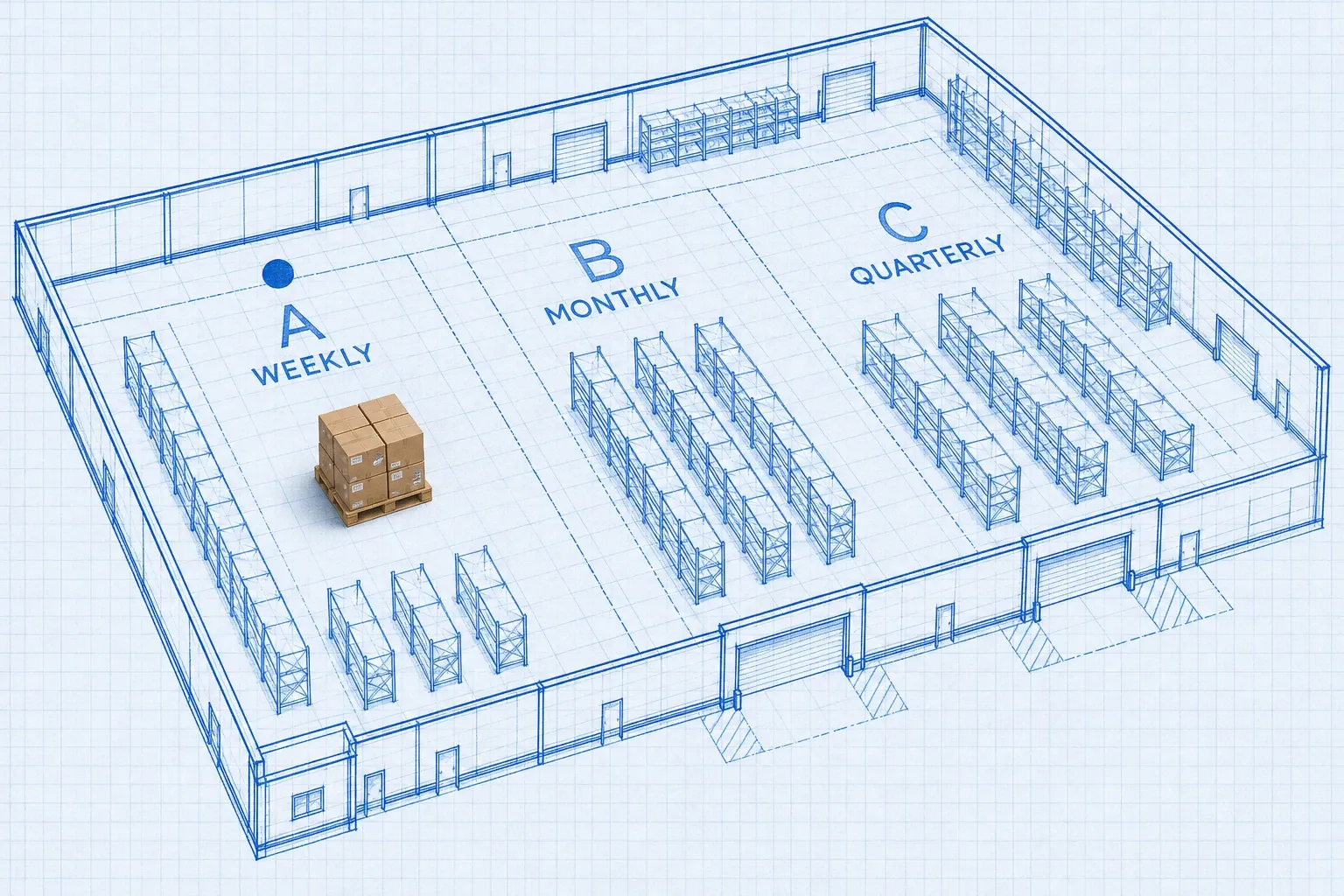
Not every SKU earns the same attention. Use ABC inventory classification to set frequency from risk:
Class | Typical share of value or velocity | Count cadence | Why |
|---|---|---|---|
A | Top ~20% of SKUs driving most revenue or picks | Weekly (daily for extreme movers) | Errors here hurt first |
B | Middle band | Monthly or biweekly | Material, not dominant |
C | Long tail | Quarterly | Low impact per miss |
Set daily count volume from labor reality. If you have 2,000 A locations and want weekly coverage, you need about 400 A counts per week, or roughly 80 per weekday. Build the schedule in the WMS so supervisors assign work, not spreadsheets.
Add trigger counts, not only calendar counts
Scheduled ABC counts catch drift. Trigger counts catch fires:
- Zero-hit picks: location empty when the system expects stock
- Short or over picks: quantity on the shelf does not match the task
- Negative on-hand attempts: the system is about to go below zero
- Receiving mismatches: ASN or PO quantity disagrees before putaway
- Returns restock: count the bin after a restock if the SKU is A-class
Trigger counts are cheap because someone is already at the location. Use them.
Run blind counts with mandatory recounts
If counters see the system quantity first, they confirm what they expect. Blind counting forces a real count, then reveals the book quantity. Variances outside tolerance (often ±2% or ±1 unit for discrete SKUs) get an independent recount before any adjustment posts. No silent "fix to match."
Keep shipping while you count
Count during lower-activity windows for that zone, soft-lock only the location being counted, and release it as soon as the count (or recount) closes. Do not lock an entire aisle for an afternoon. Directed work in a modern WMS makes this practical: pickers get sent around the locked bin instead of into it.

How do you stop new errors from wiping out your gains?
Cycle counting cleans the past. Process design protects the future. Without both, you climb to 97% and fall back to 94% every peak season.
Make receiving the first gate
Require quantity verification before putaway confirmation. Prefer blind receive for high-value or high-variance suppliers. Do not let product hit a bin until the receipt is accepted. Capture lot, expiry, or serial data at the dock if your catalog needs it. Wrong master data at receiving becomes "inventory inaccuracy" forever after.
Verify every warehouse touch with a scan
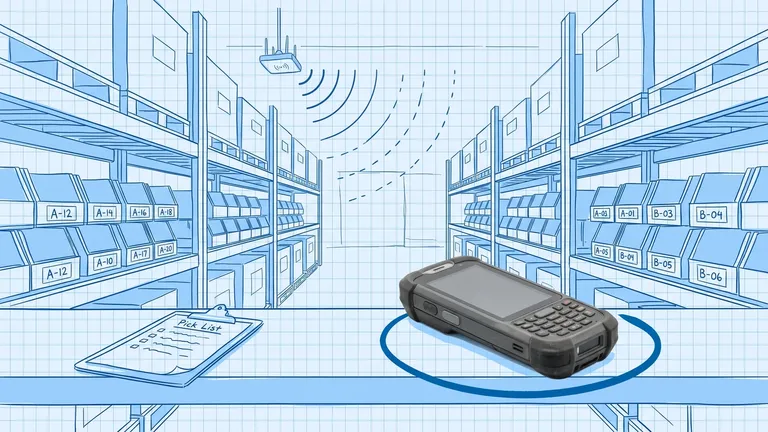
Paper pick tickets and typed quantities cannot support 99%. Barcode scanning at receive, putaway, pick, pack, and count removes transcription errors and forces location confirmation. If the scanner expects A-12-04 and the picker is at A-12-05, stop the transaction. That single rule prevents a large share of mispicks and location drift.
Separate lookalikes and velocity in slotting
Adjacent similar SKUs invite the wrong grab. High-velocity items in hard-to-reach slots invite shortcuts. Slotting will not invent accuracy alone, but bad slotting will keep manufacturing errors your counts then have to clean up.
Own adjustments with reason codes
Every adjustment needs a cause: receiving miss, mispick, damage, theft/shrink, system duplicate, putaway to wrong bin, return not scanned, and so on. Review the top reasons every week in a 30-minute huddle. Train or redesign the process behind the top two causes. Accuracy without root cause is just counting theater.
What does a 90-day path to 99% look like?
You do not need a year-long program. You need a tight sequence.
Days 1 to 14: Baseline and stop the bleeding
- Count a representative sample of 200+ SKUs across A, B, and C.
- Calculate item-level, quantity, and value-weighted accuracy.
- List the top ten variance SKUs by dollar impact and the top three reason themes.
- Freeze freehand quantity edits. Adjustments require a count or a documented exception.
- Confirm scanners work at receive and pick for every active associate.
Days 15 to 45: Stand up the cycle-count engine
- Finalize ABC classes and daily count quotas.
- Enable blind counts and recount rules in the WMS.
- Soft-lock locations during counts so shipping continues elsewhere.
- Start trigger counts for zero hits and receiving mismatches.
- Publish a simple floor board: accuracy %, counts completed, open variances older than 24 hours.
Days 46 to 90: Fix causes and lock the gains
- Run a weekly root-cause review with ops and inventory control.
- Retrain the dock on the top receiving miss pattern.
- Separate the worst lookalike SKU pairs in slotting.
- Raise A-item cadence if variance remains above tolerance.
- Recalculate the full accuracy sample and compare to day 1.
Most mid-market sites that execute this sequence see a clear move out of the low-to-mid 90s within a quarter. Crossing into a stable 99% usually follows once reason codes stop repeating. Tools like BinLogic WMS help by directing bin-level scans, scheduling ABC counts, and keeping adjustment history attached to each location so the weekly review is data, not memory.
How do you keep 99% inventory accuracy once you get there?
Hitting 99% once is a project. Keeping it is a habit.
Protect the dock. New SKUs, new suppliers, and peak ASNs are where accuracy dies first. Keep blind or verified receive rules even when the line is long.
Never skip A counts for "busy season." Peak is when you need accuracy most. Shrink the C cadence before you cut A.
Audit the auditors. Spot-check a sample of completed counts each week. If counters always match book quantity within one unit, your blind process may be leaking.
Watch trend, not vanity. A site at 97% climbing is healthier than a site at 99.2% falling after peak. Chart a 13-week rolling average.
Align finance and ops on one number. If finance uses value-weighted accuracy and ops uses item match rate, publish both. Do not let the teams argue past each other.
Know when a physical still makes sense. New building, major WMS cutover, or auditor requirement can justify a focused count. Even then, prefer zone-by-zone counts over a full freeze whenever volume allows.
What mistakes keep warehouses stuck below 99%?
- Counting without correcting process. You will recount the same SKUs forever.
- Showing book quantity to counters. Confirmation bias kills the program.
- Blended accuracy only. A items can be failing while C items pad the average.
- Punishing honest misses. People hide variances; the system goes quiet and wrong.
- Skipping location verification. Quantity-only discipline still creates empty picks.
- Treating the WMS as optional. Spreadsheets cannot soft-lock bins, direct recounts, or store reason codes at scale.
Closing: accuracy is an operating system, not an event
99% inventory accuracy without shutting down is achievable when you treat inventory control like receiving and shipping: daily work with clear owners, measurable outputs, and tools that force the right scan at the right bin. Replace the annual freeze with ABC cycle counts, stop errors at the dock, verify every touch, and spend thirty focused minutes a week on the reasons behind adjustments.
If your accuracy is stuck in the low 90s, start with a baseline sample this week, not a shutdown plan for next quarter. The warehouses that stay at 99% are not lucky. They are consistent.
Ready to put cycle counts, bin-level scans, and reason-coded adjustments on one floor system? See how BinLogic WMS supports continuous inventory control without pausing fulfillment.
Frequently asked questions
Can you really hit 99% inventory accuracy without a full physical inventory?
Yes. World-class warehouses reach 99% and above with disciplined cycle counting, not by freezing the building once a year. You still need a clean baseline when you start, but ongoing accuracy comes from continuous counts, scan verification, and fixing the same root causes every week.
How long does it take to move from average accuracy to 99%?
Most mid-size operations see a clear lift within 60 to 90 days if they baseline honestly, start ABC-based cycle counts, and close variances within 24 hours for A items. Getting from the mid-90s to a stable 99% usually takes another quarter of root-cause work, not more software alone.
What inventory accuracy formula should we use?
Use item-level accuracy: (SKUs with zero variance divided by SKUs counted) times 100. Track quantity accuracy and value-weighted accuracy separately so finance and operations see the same truth. Report A, B, and C classes on their own so slow movers do not hide problems in your bestsellers.
Do we still need an annual physical if we cycle count?
Many sites keep a lighter year-end sample for audit, not a wall-to-wall shutdown. Once cycle counts cover every location on a defined cadence and variance trends are stable, a full freeze is rarely the best use of labor. Confirm what your auditors and lenders actually require before you drop it.
What tools matter most for 99% inventory accuracy?
Barcode scanning at receive, putaway, pick, and count is non-negotiable. A WMS that directs bin-level tasks and stores reason codes for every adjustment matters more than another spreadsheet. Tools like BinLogic WMS automate location checks and count schedules so the floor does not depend on memory.
Plan the route. We deliver the rest.
See how Binlogic powers last-mile logistics — routing, tracking, and the platform that turns the plan into the package on the doorstep.
Book a callback