
















How to Run a Paperless Warehouse, and the Paper You Still Need
Most warehouse records, including count sheets, receiving tallies, forklift certifications and injury logs, can be kept electronically in the US. Two things stay physical: the hazmat shipping paper that rides in the cab for fully regulated highway shipments, and the labels on cartons and pallets; bills of lading depend on your carriers. A paperless warehouse is one that can reproduce any record on demand, not one with no printer.
Most of the paper in a US warehouse can go. Count sheets, receiving tallies, pick lists, putaway tickets, forklift certifications and injury logs can all be kept as electronic records. Two things stay physical, and a third depends on your trading partners, so they are worth knowing before anyone promises a "fully paperless" floor. One is the hazmat shipping paper that travels in the truck cab for fully regulated highway shipments. Another is the labels on cartons and pallets. The third is the bill of lading. The useful test for a paperless warehouse is not whether you own a printer. It is whether you can produce any record, in the form an inspector, auditor or customer contract requires, when it is asked for.
This guide covers what the rules allow, what they still require on paper, the order to take paper off the floor, and how to check that the electronic version holds up.
Can a warehouse legally run without paper records?
For most records, yes. The federal e-signature law (ESIGN, 15 U.S.C. 7001) says a signature, contract or other record "may not be denied legal effect, validity, or enforceability solely because it is in electronic form." It also covers retention of contracts and other transaction records: where a law requires you to keep one, that duty "is met by retaining an electronic record" as long as it accurately reflects the information and stays accessible "in a form that is capable of being accurately reproduced for later reference, whether by transmission, printing, or otherwise."
Records that exist because a safety agency requires them rest on that agency's own rule, and the ones a warehouse meets most often allow electronic records or set no format:
- Transportation records, if you run a private fleet or act as a carrier or broker. FMCSA's rule at 49 CFR 390.32 lets anyone required to "generate, maintain, or exchange documents" do so electronically, for documents they must retain (it does not cover documents submitted directly to FMCSA). The record-preservation rule for carriers, 49 CFR 379.7, says records "may be preserved by any technology that accurately reflects all of the information in the record and remains accessible."
- Forklift certifications. OSHA's standard, 29 CFR 1910.178(l)(6), says the certification "shall include the name of the operator, the date of the training, the date of the evaluation, and the identity of the person(s) performing the training or evaluation." It names the contents and sets no format, which means no paper requirement rather than an explicit permission. Operators must also be re-evaluated at least once every three years, which is easier to track in a system than in a binder.
- Injury and illness logs. Under 29 CFR 1904.29, "if the computer can produce equivalent forms when they are needed," you may keep OSHA records on the computer. Cases still have to be entered within seven calendar days of receiving information that a recordable injury or illness has occurred.
None of this requires a particular software product. It requires that the record is complete and that you can get it back out.
What paper can't a warehouse get rid of?
Two kinds of paper stay, and a third depends on your trading partners.
The hazmat shipping paper. ESIGN itself carves it out. Section 7003 says the law does not apply to "any document required to accompany any transportation or handling of hazardous materials, pesticides, or other toxic or dangerous materials." For highway shipments, the Hazardous Materials Regulations then say a carrier may not transport hazmat "unless it is accompanied by a shipping paper" (49 CFR 177.817). That paper has to be within the driver's reach, in a holder on the inside of the driver's door, or on the driver's seat when the driver is out of the vehicle. In a 2022 request for information, PHMSA described the rules plainly: they "currently require that hazard communication be maintained as physical, printed documents during transportation."
That has not changed for shipping papers. In August 2026 PHMSA published a final rule (HM-268D, effective September 3, 2026) that gives domestic carriers the option to keep emergency response information in electronic format instead of a printed copy. It does not cover the shipping paper itself. Not every hazmat package needs one: the shipping-paper rules exempt limited quantity packages, among others, "unless the material is offered for transportation by aircraft or vessel" (49 CFR 172.200(b)). But a fully regulated hazmat shipment by road still leaves with paper. Which of your products fall where is a question for whoever holds your hazmat training, not for the WMS project.
What can be electronic is your own retained copy. Under 49 CFR 172.201(e), the shipper keeps a copy "or an electronic image thereof" for two years (three for hazardous waste) and must produce it on request.
Carton and pallet labels. A label is not a paperwork problem. It is how the physical unit connects to the data. GS1's logistic label guideline says "the SSCC is the single mandatory element for all GS1 Logistic Labels" and that scanning it "allows the physical movement of units to be matched with the electronic business messages that refer to them." Which cartons and pallets need one is usually set by your customers' requirements, and going paperless tends to add labels rather than remove them, such as location and license-plate labels, because every scan depends on one. If you are setting up GS1 numbering for the first time, start with how a GS1 company prefix works.
The bill of lading, depending on who you ship with. ESIGN's exceptions also cover most of the Uniform Commercial Code, and where state law governs a document of title, electronic versions rest on UCC Article 7 rather than ESIGN, with its own rule about which copy is authoritative. In practice, whether your bills of lading go electronic depends on your carriers and customers, not just on you. Your carrier's own retention of bills of lading is set by 49 CFR Part 379; yours depends on your contracts and your accountant.
What paper should come off the floor first?
Start where paper creates a second copy of the truth. Any sheet someone fills in by hand and someone else types in later is a record that can disagree with the system. The difference may not surface until the next count. Keep in mind that counts measure accuracy, while receiving and putaway create it. A sensible order:
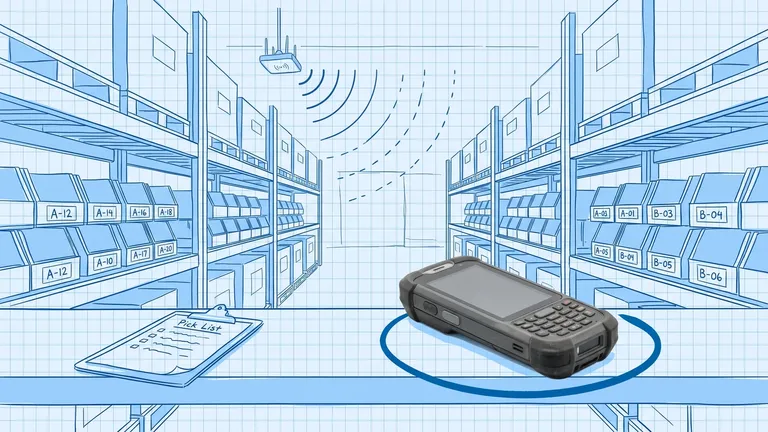
- Count sheets. A cycle count written on paper and keyed in later adds a transcription step to the one process meant to catch errors. Moving counts to a handheld is often the cleanest pilot, because a count is self-contained and easy to try in one zone, but if receiving and putaway stay on paper, handheld counts will mostly find upstream errors faster. The cycle counting guide covers how to set up the program itself.
- Receiving tallies. A receiver's handwritten tally against a packing list becomes the stock record when it is keyed in. Scanning at the dock makes the receipt and the record the same event, provided you also have a process for the exceptions: unlabeled cartons, overs, shorts and damage.
- Pick lists. A printed pick list is a snapshot of the order at the moment of printing. An order that changes or cancels after that can still get picked. Scan-confirmed picking also checks the item, not just the location.
- Putaway and move tickets. These are the least visible paper, and a common reason a unit is "in the building but not where the system says."
Each of these depends on barcodes that scan reliably on your actual labels, in your actual light, and on enough charged devices for every shift. The barcode scanning guide covers device types, label quality and Wi-Fi coverage.
Two cautions that are our recommendations, not rules. First, plan for outages. If the system is hosted and the network drops, printing from it may stop too, so the fallback has to exist before the outage: a pre-printed or cached wave, a local printer, or a device mode that works offline, plus a plan to enter paper picks back into the system afterwards, which reintroduces the transcription step for that period. Paperless should not mean stopped. Second, do not let packing slips and customer-facing documents drive the project. Whether paper goes in or on the box is a customer or compliance decision, not a floor-accuracy decision.
What does "paperless" have to prove when someone asks?
Several rules care less about whether a record is digital than about whether you can produce it, quickly and in a usable form.
- Food traceability, if you handle foods on FDA's Food Traceability List. FDA's food traceability rule (21 CFR 1.1455) lets you keep "original paper or electronic records or true copies." When FDA requests them, you must produce them within 24 hours, or a reasonable time FDA agrees to. For certain records you must provide them "in an electronic sortable spreadsheet," with exemptions for small farms and for retailers and others under the rule's sales threshold. On timing: the original compliance date was January 20, 2026. FDA has proposed moving it to July 20, 2028, and Congress has directed FDA not to enforce the rule before that date. As of October 2026 the new date is a proposal backed by that directive, not a final rule.
- OSHA logs. Computer records are acceptable only if the system can produce equivalent forms "when they are needed."
- General retention. ESIGN's own test is a record that can be "accurately reproduced for later reference."
So a paperless warehouse is not finished when the paper stops. It is finished when someone has run a mock request and the system produced the record. That might mean an OSHA log printed in the right form, a disputed receipt pulled with its scan history, or, if you are covered by the food traceability rule, a lot traced from receipt to shipment as a sortable spreadsheet within a day. If it takes an engineer and a weekend, that is the real gap.
A short checklist
- List every paper form on the floor and mark who fills it in and who retypes it.
- Remove retyped forms first: counts, receiving, picks, moves.
- Keep hazmat shipping papers printed and in the cab where the rules require them. Keep your retained copy electronic if you like.
- Treat labels as part of the system, not paper to eliminate.
- Write down the exception process for receiving: unlabeled cartons, overs, shorts and damage.
- Ask carriers and customers whether they accept electronic bills of lading before you plan around it.
- Run a mock records request (traceability, OSHA, a disputed receipt) and time it.
- Set up an outage fallback before you need it, and a way to enter paper work back into the system.
Frequently asked questions
Is a fully paperless warehouse legal in the US?
For most records, yes. Federal e-signature law says a record cannot be denied legal effect solely because it is electronic. OSHA's injury rule allows computer records, its forklift rule sets no format, and FMCSA allows electronic copies of documents you must retain. The main exception is hazmat: that law excludes documents that must accompany hazardous materials, and a fully regulated highway shipment still needs a printed shipping paper in the cab.
Can forklift certifications and injury logs be kept electronically?
Yes. OSHA's forklift rule lists what a certification must contain (operator name, training date, evaluation date and who trained or evaluated) but sets no format. OSHA's injury recordkeeping rule lets you keep records on a computer if the system can produce equivalent forms when they are needed. Test that the system can actually print or export those forms before you retire the paper versions.
What should a warehouse take off paper first?
Start with records your team writes by hand and someone retypes later: count sheets, then receiving tallies, then pick lists. Each of these creates a second copy that can disagree with the system. Replace them with scan-confirmed tasks on a handheld, keep a printed fallback for outages, and leave carton labels and hazmat shipping papers alone, because those are meant to be physical.
Plan the route. We deliver the rest.
See how Binlogic powers last-mile logistics — routing, tracking, and the platform that turns the plan into the package on the doorstep.
Book a callback