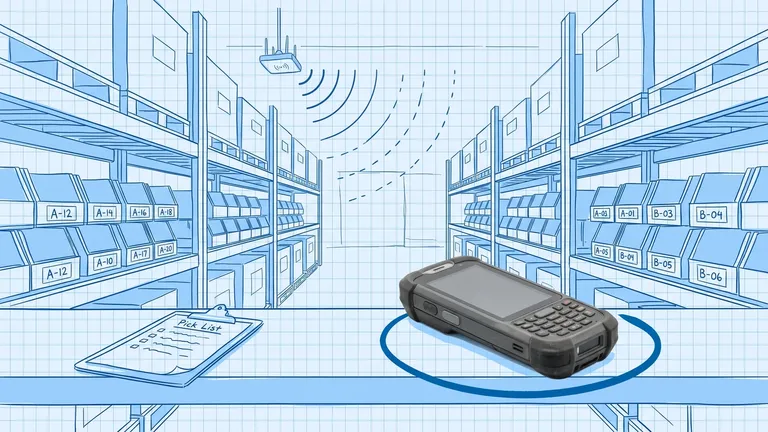

















How Often Should You Count Your Warehouse Inventory?
How often you count warehouse inventory depends on each item's value and velocity. A-class items (top 20% by revenue) should be counted weekly or monthly, B-class items monthly to quarterly, and C-class items quarterly to semi-annually. Running this as an ongoing cycle count program, rather than one annual physical count, keeps accuracy above 95% without shutting down your operation.
The right answer depends on the item, not the calendar. A-class items should be counted weekly or monthly, B-class items monthly to quarterly, and C-class items quarterly to semi-annually -- and all of it should run as an ongoing cycle count program, not a single annual shutdown. That cadence, driven by ABC analysis, is the standard used by warehouses that maintain inventory record accuracy above 95%.
If your operation is still running one big physical count per year and calling it done, the numbers tell a different story. According to CAPS Research, the average inventory record accuracy across surveyed warehouses in 2024 was roughly 83%. That means roughly 1 in 6 items in your system has a quantity your warehouse can't confirm is right.
Here's how to fix that with a counting schedule that actually holds.
What Is the ABC Method for Setting Count Frequency?
ABC analysis classifies your inventory into three tiers based on value and velocity:
- A-class items are the top 10 to 20 percent of SKUs by revenue or turnover. They drive 70 to 80 percent of your total inventory value or sales volume.
- B-class items sit in the middle. They account for the next 30 percent of SKUs and a moderate share of value.
- C-class items are the remaining 50 to 60 percent of SKUs. They move slowly and carry low individual value.
ABC inventory classification matches counting effort to financial risk. When an A-item record is wrong, you get stockouts, mis-picks, and customer failures. When a C-item record is off by a few units, the impact is minor. Spending equal time counting both wastes labor and still leaves your highest-risk items under-monitored.
Recommended count frequencies by class
Class | Count frequency | Target accuracy |
|---|---|---|
A | Weekly or monthly | 98%+ |
B | Monthly or quarterly | 96-98% |
C | Quarterly to semi-annually | 94-96% |
These are starting points, not rigid rules. If a C-class item is a critical component that would halt your production line if it ran out, count it like an A-item regardless of its dollar value.
How Often Should You Count A Items?
Count A items at least once a month. If they are high-velocity (turning over weekly), count them weekly. These are your most counted SKUs because they accumulate errors the fastest. Every time an A-item is picked, received, or moved, there is a chance the system record drifts from reality. Frequent counts catch those drifts before they cascade into a customer problem.
Most A-items only represent a small share of your total SKU count, so the time commitment is manageable. A warehouse with 5,000 SKUs might have 500 to 1,000 A-class items. Spread over four weeks, that's 125 to 250 items to verify each week -- a number most teams can absorb in a daily 20 to 30 minute count window.
How Often Should You Count B and C Items?
B items: monthly to quarterly. They do not generate errors as fast as A items, but they still deserve regular attention. A quarterly cycle is the outer limit -- beyond that, discrepancies start to compound and reconciliation becomes harder.
C items: quarterly to semi-annually. Some organizations count them annually, but quarterly is safer. Slow-moving items are easy to forget and easy to misplace during a warehouse reorganization. A quarterly sweep keeps the records honest without taking much time, since C-items are also the ones that take seconds to scan and confirm.
A common practical schedule looks like this: every morning, count a small batch of A-items in a specific zone. Once a week, run through the week's B-item batch. Once a month, sweep through the C-item queue. Over a rolling 90-day window, every SKU in the warehouse has been verified.
Why Annual Physical Counts Fall Short
The annual physical inventory is a warehouse operation stopper. You close receiving, pause shipping, bring in extra staff, and spend one to three days counting everything at once. The result is a snapshot that is accurate at that specific moment -- and starts drifting the second you reopen the dock doors.
According to the Council of Supply Chain Management Professionals (CSCMP), companies with formalized cycle counting programs achieve average inventory record accuracy above 95%, compared to below 85% for those relying solely on annual counts. The gap is not small.
The operational cost compounds too. Annual counts require overtime or temporary labor, disrupt fulfillment windows, and often produce errors from the sheer pace of the count. A team rushing through 10,000 SKUs in two days will miss things a two-person team doing 50 locations in a quiet morning would catch.
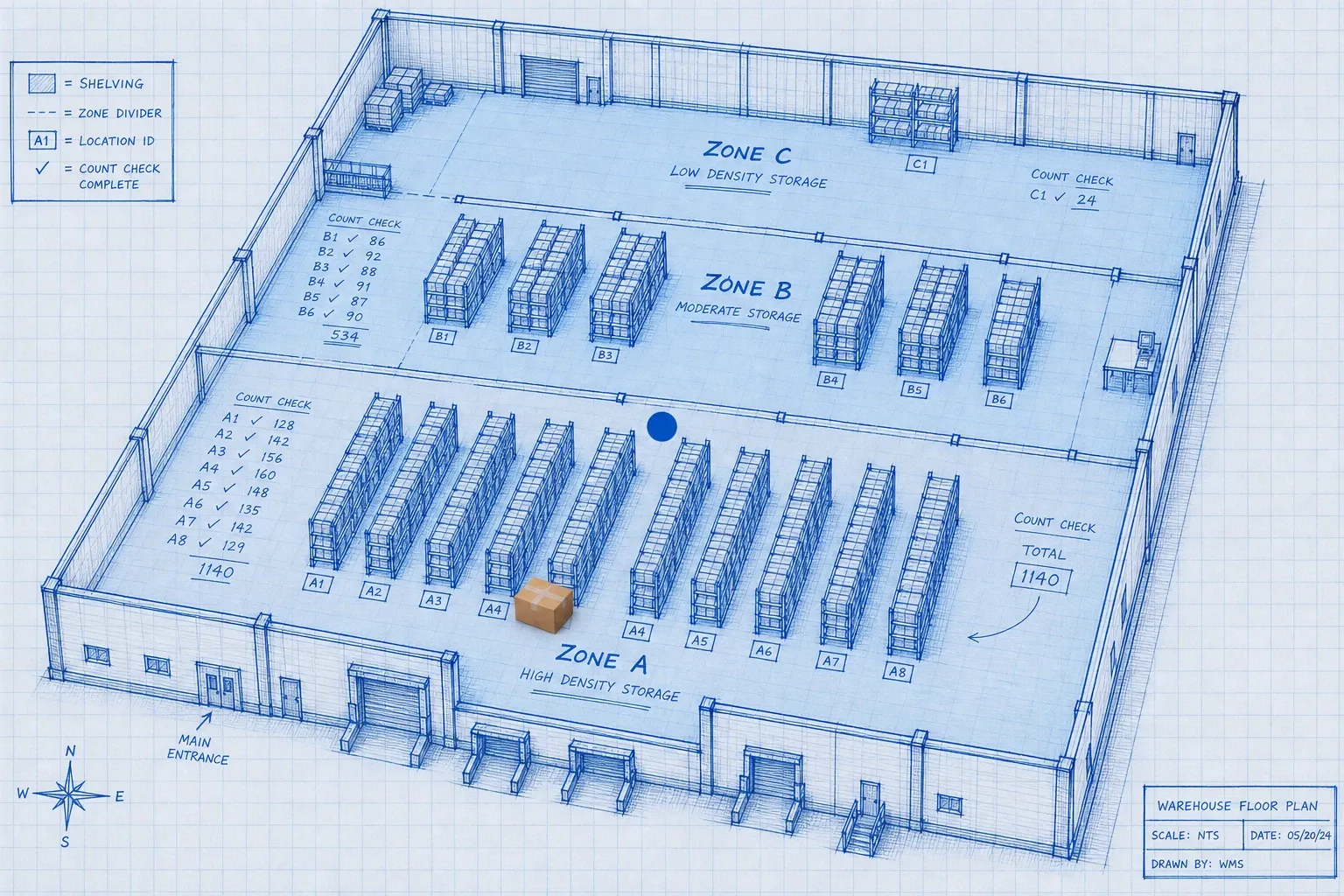
Cycle counting does not eliminate the annual physical count entirely for everyone. Finance teams, external auditors, and some regulatory environments still require a full wall-to-wall count once a year. But when your cycle program has been keeping records accurate all year, that annual count becomes faster, less stressful, and rarely produces surprises.
When Should You Count More Often Than Your Schedule Says?
Your ABC schedule is the baseline. Certain events should trigger a count outside the normal cadence:
- After a receiving error. If a PO comes in with a discrepancy, count the affected SKUs immediately. Do not wait for the next scheduled window.
- After a system migration or WMS upgrade. Any time you touch the software that holds the records, verify the high-value items before resuming normal operations.
- After a return wave. Returns create some of the messiest inventory situations. If you run a large return processing event, count the affected locations when it is done.
- When an item flags a variance twice in a row. If the same SKU counts wrong two cycles in a row, something is wrong at the process level -- a mislabeled bin, a systematic pick error, or a receiving workflow gap. Promote it to A-class temporarily and investigate.
High-shrinkage items deserve their own treatment regardless of ABC class. If you know certain SKUs tend to disappear, count them more often than their class would suggest. The counting schedule is a starting framework, not a ceiling.
How to Build a Realistic Counting Schedule
The formula for calculating your minimum daily count volume is straightforward:
> Total active locations in a tier divided by the count cycle in days equals locations to count per day
For example: 2,000 C-class locations on a 90-day cycle means counting at least 23 locations per day just to cover the C-tier. Add the A and B count batches on top. Most mid-size operations end up counting between 40 and 80 locations per day to stay current across all three tiers.
A few practical rules to make the schedule hold:
- Count during low-activity windows. Start-of-shift and end-of-shift counts work well. Competing with active pickers for the same aisle slows both teams and corrupts your count because items are moving while you verify.
- Always count blind. Counters should record the physical quantity before they see the system quantity. Showing the system number first anchors the counter to it -- which defeats the purpose. Blind counts produce results that actually test the system.
- Count the whole location, not just the item. If a bin holds SKU A and SKU B, count both during the same visit. Partial counts leave half the data unverified.
- Log every variance with a reason code. "Receiving error", "mis-pick", "mislabeled bin" -- each code tells you where in the process the breakdown happened. Monthly review of reason codes shows you which workflows are generating the most discrepancies.
Do You Still Need an Annual Physical Count?
For many operations, no -- at least not as a primary accuracy tool. If your cycle count program is well-run and your accuracy stays above 95%, a full annual count is redundant from an operational standpoint. It is an interruption you can shorten significantly by running your year-round counts properly.
The cases where an annual count is still worth doing:
- Your lender, auditor, or insurer requires it
- You are switching WMS platforms and need a clean starting baseline
- Your cycle count program has gaps (zones that were consistently skipped) and the records have drifted
For everyone else: a clean cycle program makes the annual physical count a formality rather than an event.
Making the Schedule Stick
The hardest part of cycle counting is not the counting itself -- it is keeping the program running when the warehouse gets busy. It is easy to skip the morning count during a peak week and then find yourself three months behind.
Tools like BinLogic WMS automate this by generating daily count tasks based on ABC class, last-count date, and zone. The system tells your team what to count each day, tracks completion rates, and flags overdue locations. That removes the manual scheduling effort that causes most cycle count programs to quietly stop running after a few months.
The goal is an accurate warehouse every day of the year, not just the day after the annual count. A well-set counting schedule, matched to your ABC classification, is the most practical way to get there.
Related reading:
Frequently asked questions
How often should A, B, and C items be counted?
A-class items (high value or fast-moving) should be counted weekly or monthly. B-class items do well on a monthly or quarterly schedule. C-class items (slow-moving, low value) can be counted semi-annually or annually. The goal is to spend your counting effort where a discrepancy would hurt most.
Can cycle counting replace an annual physical inventory?
For most operational purposes, yes. A well-run cycle count program keeps inventory record accuracy above 95% year-round. Many warehouses still do one annual count for financial reporting or audit requirements, but it becomes much faster and less stressful when cycle counts have kept the records clean all year.
What is a good inventory record accuracy rate?
Industry benchmarks put 95% as the minimum acceptable rate, with world-class operations targeting 97% to 99%. According to CAPS Research, the average across surveyed warehouses in 2024 was roughly 83%, meaning most operations have real room to improve with a structured counting program.
How do you decide how many items to count each day?
Divide the number of active locations in a tier by the target count cycle in days. For example, 2,000 C-class locations on a 90-day cycle means counting at least 23 locations per day. Add your A and B tier counts on top of that base. Most warehouses land between 40 and 80 locations per day to maintain a full quarterly cycle.
Does a WMS automate cycle count scheduling?
Yes. A warehouse management system like BinLogic WMS can generate daily cycle count tasks based on ABC class, last-count date, and zone, assign them to specific staff, and flag items that are overdue for a count. This removes the spreadsheet-and-clipboard approach and keeps the program running without manual scheduling effort.
Plan the route. We deliver the rest.
See how Binlogic powers last-mile logistics — routing, tracking, and the platform that turns the plan into the package on the doorstep.
Book a callback