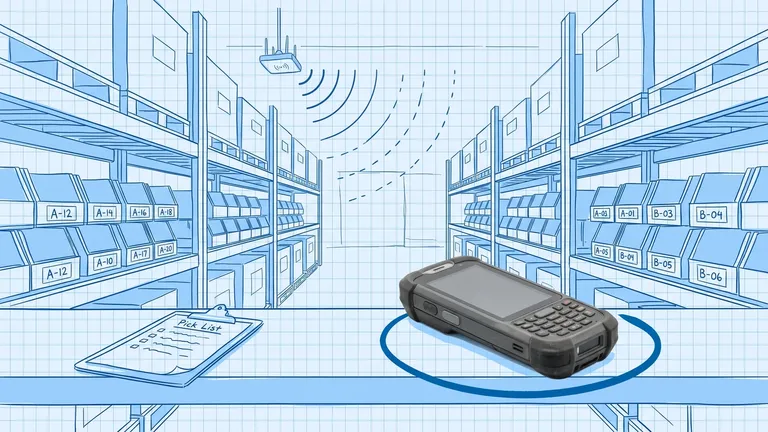

















The Real Cost of Inventory Inaccuracy (With Numbers)
Inventory inaccuracy carries a hidden cost most warehouses underestimate: stockouts, mispicks, excess carrying costs, and lost customers compound into substantial revenue losses. IHL Group estimates global inventory distortion costs retailers $1.77 trillion annually. Fixing it requires real-time visibility, cycle counts, and a WMS that keeps records accurate between counts.
Inventory inaccuracy is not a minor operational nuisance. It is a direct drain on revenue, margin, working capital, and customer retention, and most warehouses underestimate it because the losses are spread across dozens of line items rather than showing up as a single charge.
Inventory inaccuracy is the gap between what your system says you have and what is physically on the shelf, and every percentage point of that gap costs you money in at least four distinct ways: stockouts, mispicks, excess carrying costs, and emergency replenishment.
Here is where that money actually goes.
What Does Inventory Inaccuracy Actually Cost?
The clearest picture of the global scale comes from IHL Group, which has tracked inventory distortion across retail and wholesale for nearly 20 years. Their 2025 research puts the combined global cost of out-of-stocks and overstocks at $1.77 trillion annually, roughly 5% of total global retail revenue. Two-thirds of that figure, approximately $1.2 trillion, comes from stockouts. The remaining $572 billion comes from overstocks.
That is a macro number. At the warehouse level, the costs break down differently, but they are just as real.
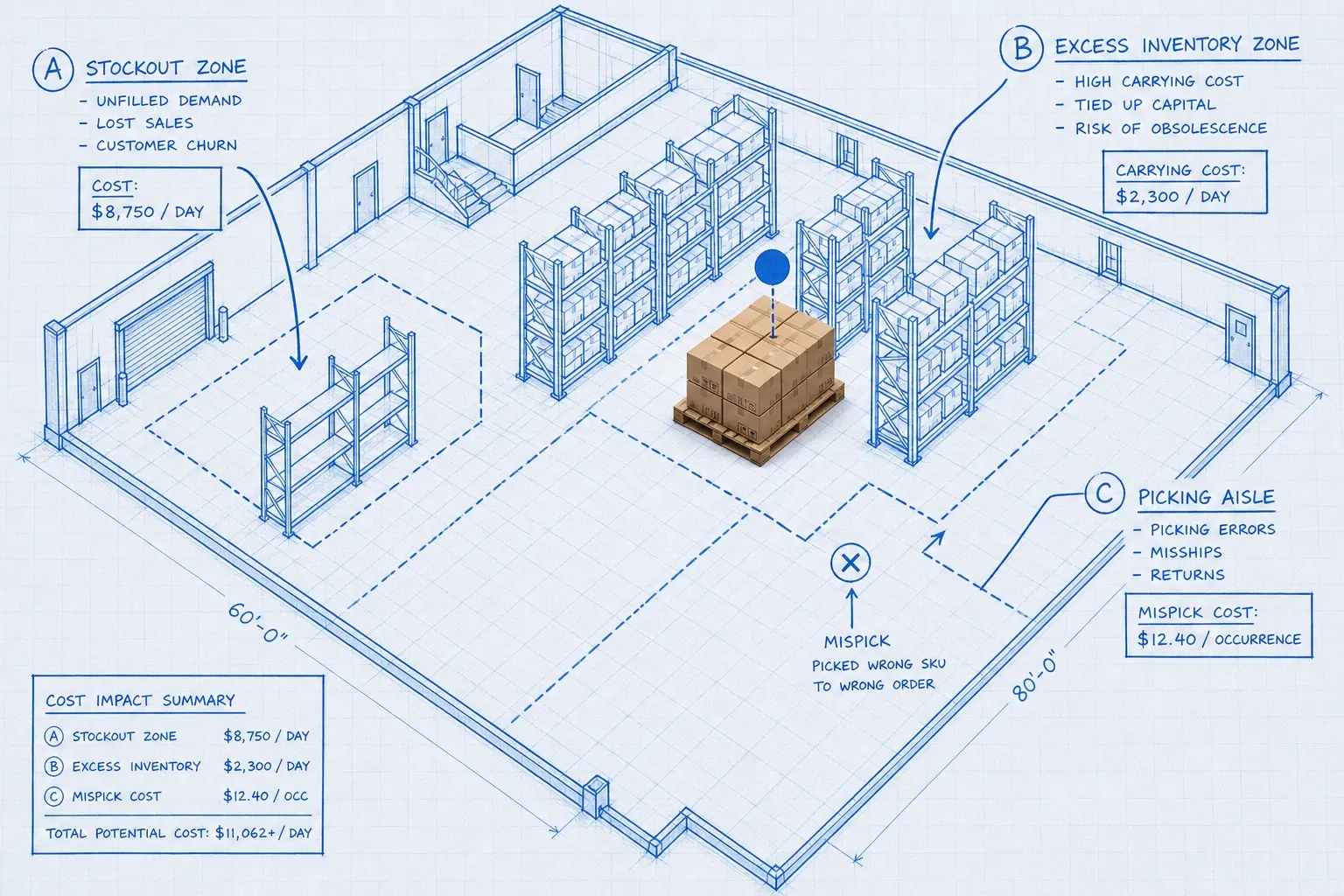
Research by Intermec surveying 250 supply chain and distribution managers across the US, UK, France, and Germany found that distribution centers lose an average of $390,000 per year from mispicks alone. A single mispick costs the facility roughly $22 to $100 depending on product value and logistics complexity, covering return shipping, labor rework, a replacement pick and reship, and customer service time. At even a modest 1% pick error rate, a mid-size operation processing 1,000 orders daily loses $130,000 per year just on order corrections.
And that is before you touch carrying costs, stockouts, or emergency procurement.
The Four Ways Inaccuracy Drains Your P&L
1. Carrying Costs from Excess Safety Stock
When you cannot trust your inventory records, your buyers compensate. They order more. They pad safety stock buffers to cover the possibility that the system is showing phantom inventory. That decision makes sense given the uncertainty, but it is expensive.
Inventory carrying costs typically run 20-30% of total stock value annually, covering warehouse space, insurance, obsolescence, and the opportunity cost of capital tied up in unsold product. A business holding $500,000 in excess safety stock because its records are unreliable is spending $100,000 to $150,000 per year for the privilege of not trusting its own data.
The math gets worse if you sell on Amazon. Aged inventory surcharges kick in at 15 months and can add $0.35 per unit or $7.90 per cubic foot, a penalty on top of the capital you already have sitting idle.
2. Stockout Losses and Emergency Replenishment
A stockout has two costs: the immediate lost sale and the customer you may lose for good.
When a customer hits an out-of-stock, the immediate revenue loss is clear. What is less visible is the emergency replenishment cost that follows. Correcting a stockout through urgent procurement typically costs three to five times more than standard purchasing : expedited shipping, premium supplier pricing, rush fulfillment labor. This wipes out the margin on the eventually sold goods.
The longer-term cost is retention. Research cited by Linnworks shows 75% of customers are likely to switch to a competitor after experiencing just two stockout incidents. That is not two stockouts with the same customer over a year; that is two incidents total before they stop buying from you. If your average customer lifetime value is $500, losing even 10 customers to stockout frustration costs $5,000, for a problem that had nothing to do with your product quality.
3. Mispicks and Fulfillment Errors
A mispick is when your team picks the wrong SKU, wrong quantity, or wrong variant for an order. It happens because the pick list reflects system records, and if those records are wrong, the pick is wrong before anyone even reaches the shelf.
Industry research puts the cost of a single mispick at $22 to $100 for standard goods, and higher for fragile, perishable, or high-value items. The expenses pile up quickly: the return shipping (often absorbed by the seller), the labor to receive and restock the wrong item, the pick and reship of the correct item, and the customer service time to handle the complaint.
About 30% of customers who receive the wrong item will not reorder, according to research from Olimp Warehousing. So every mispick is simultaneously a cost event and a churn risk.
4. Labor Waste from Constant Firefighting
This is the cost that never shows up on a single invoice but you feel it in every shift. When inventory records cannot be trusted, your team spends time that should go into productive work on non-productive recovery: searching for items the system says are in bin A3 but are actually on a pallet in receiving, doing unplanned recounts, expediting orders that should have shipped two days ago.
A warehouse with 95% inventory accuracy might spend 10-15 hours per week just fixing inventory-related errors. At a $20/hour fully loaded labor rate, that is $10,400 to $15,600 per year, for a facility that is already performing better than most.
For operations running at 65-75% accuracy (which is where most manual and basic barcode operations land, according to Dexory research), the labor waste is significantly higher. The recounts, the re-picks, the customer service escalations, and the management time spent investigating discrepancies all compound.
Why Most Warehouses Underestimate Their Accuracy Problem
Here is the uncomfortable part: most warehouses think they are more accurate than they are.
Self-reported inventory accuracy rates tend to be high, typically 95% or better, because they are measured against system-to-system reconciliations or infrequent physical counts. But when you measure the gap between what the system says and what is actually on the shelf on any given day, the numbers are different.
Dexory research found that businesses relying on manual barcode-based systems actually operate at 60-75% inventory accuracy on a real-time basis, despite often reporting higher figures. The discrepancy exists because errors accumulate between counts: a missed scan here, an unlabeled return there, a receiving record with the wrong unit count. Each event is small. Over weeks, they compound.
The result is a widening gap between the clean number in your dashboard and the messy reality in your warehouse. And because most organizations only do a full physical count once a year, they operate with stale data for months at a time.
What Good Looks Like
Best-in-class operations maintain 99.5% inventory accuracy or higher. That is not an unreachable target, but it requires a different approach than an annual physical count.
The path most high-accuracy warehouses follow:
Cycle counting replaces annual shutdowns. Rather than counting everything once a year and accepting whatever drift has accumulated, you count portions of your inventory continuously. High-velocity SKUs get counted weekly. Lower-velocity SKUs get counted monthly or quarterly. You catch and correct errors as they happen rather than discovering six months of drift at once. The guide to setting up cycle counting covers how to structure this by SKU velocity and warehouse zone.
Real-time scan events at every movement. Accuracy degrades at every point where inventory moves without a scan: receiving, put-away, pick, pack, transfer between locations, and returns. Each unscanmed event is a potential discrepancy. Closing those gaps requires either process discipline or automation at each touchpoint.
A WMS that updates records at the transaction level. A spreadsheet or basic stock tracker updates when someone remembers to update it. A warehouse management system like BinLogic WMS updates the moment a scan event happens, so the record reflects reality, not what someone manually entered at the end of a shift. This is the operational baseline for maintaining accuracy above 99%.
Blind counts for higher-confidence results. A blind count removes the system quantity from the counter's view so they count what they actually see, not what they expect to see. This eliminates confirmation bias from physical counts and produces more reliable reconciliations.
The Return on Fixing It
The payback from improving inventory accuracy is fast. Rushorder research puts the typical payback period at 6-12 months for operations that implement better cycle counting processes and real-time tracking.
Here is a concrete example of how that math works. A mid-size operation holding $1 million in inventory, running at 75% accuracy, is likely carrying $150,000-$250,000 in excess safety stock. Bringing accuracy to 95% allows you to safely reduce that buffer, releasing 75,000 to 150,000 dollars in working capital. Add the mispick cost reduction, the labor savings from fewer emergency recounts, and the customer retention improvement from fewer stockouts, and the ROI calculation becomes straightforward.
The cycle count vs physical inventory comparison breaks down the trade-offs between approaches if you're deciding where to start.
Where to Start
You do not need to solve everything at once. Most operations that improve accuracy materially do it in three stages:
Stage 1: Measure your real accuracy. Do a surprise count on 100-200 SKUs chosen at random. Compare the physical count to the system record. The gap you find is your actual accuracy problem, not the number in your last annual audit.
Stage 2: Close the biggest leak first. For most warehouses, the largest single source of inaccuracy is receiving: incorrect unit counts, wrong SKUs logged, unlabeled bulk transfers. Fixing the receiving process with better scan discipline and a receiving checklist typically improves accuracy by 5-10 percentage points on its own.
Stage 3: Implement cycle counting. Once you have the receiving process solid, start a cycle count program for your top-20% of SKUs by volume. Count them weekly. Fix discrepancies immediately. Then expand the program.
Tools like BinLogic WMS automate the cycle count scheduling, flag discrepancies in real time, and update records at the scan level, so you are not relying on manual reconciliation to hold the accuracy gains you have worked for.

The Numbers That Matter
Inventory inaccuracy is not abstract. It shows up in your carrying cost line, your mispick rate, your emergency freight bills, and your customer churn. The IHL Group figure of 1.77 trillion dollars globally is a striking headline, but the number that actually matters is yours.
Take your current inventory value, apply a 20-30% carrying cost estimate to the portion you're holding as excess safety stock, add your average mispick count times $22-$100 per incident, and add an estimate for emergency replenishment costs from stockouts. That total is your accuracy tax, the amount your operation is spending because your records do not match your shelves.
For most mid-market warehouses, it is six figures. For larger operations, it is more.
The good news is that the path to fixing it is well understood, and the tools to do it exist. The question is whether the cost of the status quo is visible enough to motivate the change.
Want to see how BinLogic WMS handles cycle counting and real-time inventory updates? [Request a demo](https://binlogic.io/demo) to walk through how accuracy tracking works in a live operation.
Frequently asked questions
How much does inventory inaccuracy cost a typical warehouse?
A single distribution center loses an average of $390,000 per year from mispicks alone, according to Intermec research. When you add carrying costs for excess safety stock (20-30% of inventory value annually) and lost sales from stockouts, total losses can easily reach seven figures for mid-size operations.
What causes inventory inaccuracy in warehouses?
The most common causes are manual data entry errors, missing scan events during receiving and put-away, returns that are not properly logged back into stock, and physical inventory checks that only happen quarterly or annually. Each gap creates a growing drift between your system records and actual shelf counts.
What is a good inventory accuracy rate for a warehouse?
Best-in-class warehouses maintain 99.5% or higher inventory accuracy. Most operations that rely on manual processes or basic barcode scanning fall in the 65-75% range, which creates significant financial exposure through stockouts, overselling, and excess safety stock.
How do you fix inventory inaccuracy?
The most effective path combines cycle counting (frequent partial counts rather than annual shutdowns) with real-time scan events at every inventory movement and a WMS that updates records at the point of each transaction. Most operations see major improvements from better processes before they even need to add RFID.
How does inventory inaccuracy affect customers?
When system records show available stock that does not physically exist, customers place orders that cannot be fulfilled. Research shows 75% of customers are likely to switch to a competitor after experiencing two stockout incidents, so the real cost includes long-term customer lifetime value, not just the immediate lost sale.
Plan the route. We deliver the rest.
See how Binlogic powers last-mile logistics — routing, tracking, and the platform that turns the plan into the package on the doorstep.
Book a callback