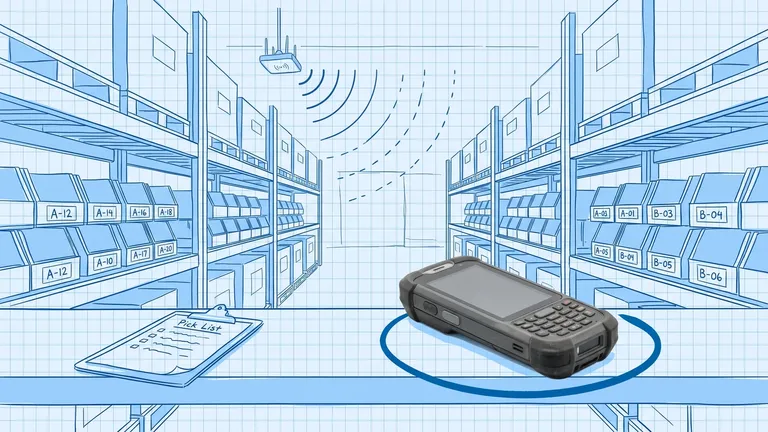

















Cycle Count vs Physical Inventory: Which Is Better?
Cycle counting beats physical inventory for most warehouses because it maintains accuracy continuously without shutting down operations. Physical inventory is still useful for year-end audits, compliance, and baseline resets. For most mid-size and high-velocity warehouses, a hybrid approach works best: cycle counts throughout the year, with a targeted full count once annually for audit purposes.
For most warehouses, cycle counting is the better choice. It keeps your inventory records accurate throughout the year without stopping operations, catches errors within days rather than months, and costs significantly less at scale. Physical inventory still has a place, but as a compliance checkpoint, not a primary accuracy tool.
Cycle counting is the practice of auditing a small, rotating portion of your inventory on a regular schedule, while physical inventory (also called a wall-to-wall count) involves counting every item in the facility at once, usually once a year.
The choice between them shapes your accuracy levels, your labor costs, and how quickly you can find and fix discrepancies. Here is what you need to know.
What Is Cycle Counting?
Cycle counting divides your inventory into groups and counts each group on a defined schedule. Instead of one massive event, your team counts a handful of locations or SKUs every day or week. Over a set period, every item gets counted at least once.
The key advantage is continuity. Your warehouse keeps operating while counts happen. A team of one to three people can run a cycle count program without pulling the whole floor off normal work.
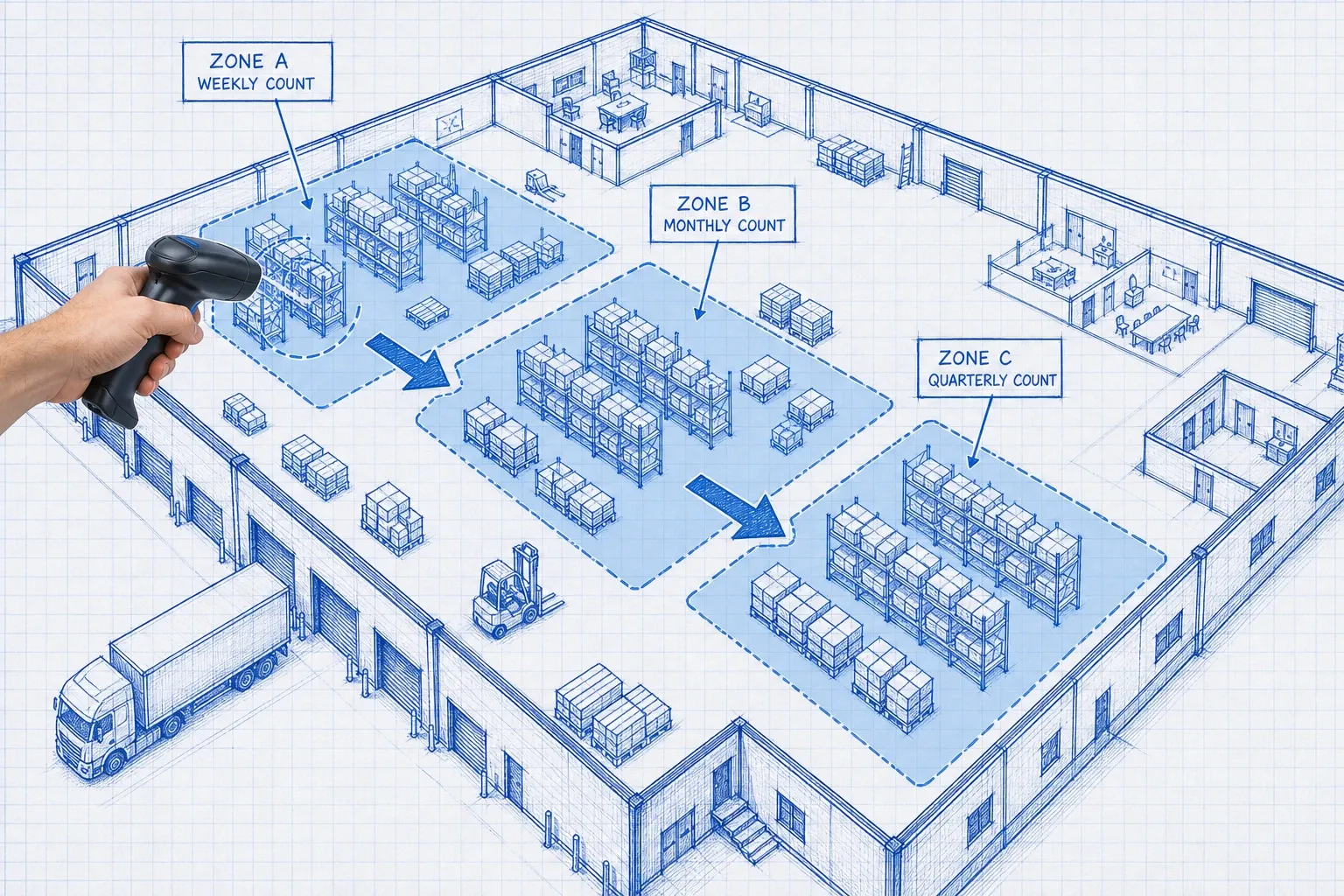
Most operations prioritize using ABC inventory classification: A-class items (high value or high velocity) get counted weekly or even daily, B-class monthly, and C-class quarterly. This focuses your counting effort where errors are most expensive.
What Is Cycle Counting in Inventory Management? covers the mechanics in detail if you want to dig into setup and scheduling.
What Is a Physical Inventory Count?
A physical count audits every item in the facility at the same time. The warehouse typically shuts down or severely limits receiving and shipping during the count to prevent items from moving and creating mismatches.
Most operations schedule this annually, often tied to a fiscal year-end or an external audit. For smaller facilities with simple inventory, a physical count can be completed in a day. For larger operations, it can take three to five days and require dozens of temporary workers.
The upside is completeness. When you finish, you have a verified snapshot of everything you hold.
Key Differences at a Glance
Factor | Cycle Counting | Physical Inventory |
|---|---|---|
Frequency | Continuous (daily, weekly, monthly) | Annual or semi-annual |
Operational disruption | Minimal, normal operations continue | High, operations typically halt |
Error detection speed | Days to weeks | Up to 12 months |
Achievable accuracy | 95-99% continuous | 92-97% point-in-time snapshot |
Cost (50K SKU facility) | $60K-$100K per year | $120K-$200K per event |
Staff required | 1-3 dedicated counters year-round | 20-100+ temporary staff for the event |
Best for | Ongoing operational control | Audit compliance, system go-lives, baseline resets |
The Accuracy Difference
This is where cycle counting pulls ahead.
According to the Council of Supply Chain Management Professionals (CSCMP), companies with formalized cycle counting programs achieve average inventory record accuracy above 95%, compared to sub-85% for operations relying solely on annual physical counts. That gap directly affects fill rates, stockout frequency, and the accuracy of your reorder decisions.
Here is the problem with physical inventory: accuracy degrades the moment the count ends. Receiving and shipping resume, picks happen, returns come in, and the system slowly drifts away from what was just verified. By month six, many warehouses have slipped back below 90% without realizing it because there is no ongoing verification.
Cycle counting closes that loop. A discrepancy found today gets investigated and corrected today, before it compounds into a larger problem. The root cause is still visible: a misscanned location, a label that fell off, a pick that was logged against the wrong SKU.
The Cost Difference
Physical inventory is expensive in ways that are easy to underestimate.
The direct costs are the obvious ones: overtime pay, temporary staffing, and the hourly cost of a partial or full shutdown. The indirect costs are larger: lost shipments, frustrated customers, delayed purchase orders, and the management time spent planning and executing the event.
According to CPCON Group, for operations managing 50,000 or more SKUs, cycle counting typically costs 40 to 60 percent less than a full physical count annually. Their figures put a 50,000-SKU facility at $60,000 to $100,000 per year for cycle counting versus $120,000 to $200,000 for one physical count event.
For smaller operations under 5,000 SKUs, the cost gap narrows. A two-day physical count is more manageable and the case for cycle counting is less urgent, though still valid.
When Physical Inventory Makes Sense
Despite the advantages of cycle counting, there are situations where a physical count is the right call.
Year-end financial audits. External auditors often require a documented full count to verify balance sheet inventory values. Even if your cycle count program is excellent, your accountant may need a wall-to-wall count for compliance.
System migrations. If you are moving to a new WMS or ERP, a physical count before cutover establishes a clean baseline. It ensures you are not migrating months of accumulated errors into the new system.
Regulatory requirements. Certain industries (pharma, food and beverage, consumer electronics with serial tracking) have specific regulatory counting requirements. Check your applicable standards.
Starting from scratch. If you have never run a formal cycle counting program, a physical count gives you the baseline to start from. You cannot cycle count accurately against a record that is already wrong.
When Cycle Counting Is the Better Choice
For most warehouses running day-to-day, cycle counting wins on every practical dimension.
You do not need to stop shipping. You do not need to hire temporary workers. Errors surface within days, not at the end of the year. Your team builds counting into a routine rather than dreading it as an event.
The 2026 Skulabs Inventory Management report puts average inventory accuracy across all companies at approximately 83 percent. That figure reflects the reality of operations that do not count consistently. A properly run cycle count program targets 95% or higher, with best-in-class operations exceeding 99% on A-class items.
If you are managing more than a few thousand SKUs, operate across multiple shifts, or sell on more than one channel, an annual physical count is not enough. You need visibility between counts, and that is exactly what cycle counting provides.
The Hybrid Approach Most Operations Use
The most common answer is not either/or, it is both.
Run cycle counts throughout the year as your primary accuracy mechanism. Then schedule one targeted physical count annually for audit purposes or as a full baseline verification. This combines the operational benefits of continuous counting with the compliance coverage of an annual audit.
What changes with the hybrid model is scope. Because your cycle counts are keeping records accurate all year, the annual physical count does not need to be a complete wall-to-wall event. Many operations count only their highest-value items or flagged locations for the audit, trimming the annual event from three days to one.
How a WMS Supports Both Methods
Running either method well without a system is harder than it needs to be.
A warehouse management system (WMS) handles the scheduling, assigns count tasks to specific team members, records results in real time, and flags variances automatically. When a count shows a discrepancy, the system queues a recount before anyone has to remember to do it manually.
Tools like BinLogic WMS build cycle count scheduling into the platform, so your team gets daily count assignments based on ABC priority, location, and last-count date, rather than managing it from a spreadsheet. The system also tracks accuracy over time so you can see which zones or product types are driving your discrepancies, and fix the root cause rather than just correcting the number.
What Is Inventory Accuracy explains how to measure and benchmark your accuracy rate if you are setting targets for your program.
If you are evaluating whether a WMS is the right next step, the counting workflow is a good starting point for the conversation. A system that makes counting easier and more consistent is one that will pay for itself in reduced shrinkage and fewer stockouts.
The Bottom Line
Cycle counting beats physical inventory for ongoing accuracy in almost every mid-size and larger warehouse. It costs less, causes less disruption, detects errors faster, and maintains accuracy that a once-a-year count simply cannot sustain.
Physical inventory still earns its place: for audits, for baseline resets, and for compliance requirements that specifically call for it.
If you are relying on an annual count as your primary accuracy method, the 83% average accuracy figure in the industry data is probably familiar. A cycle count program is the most direct path to 95% and above, without shutting down for a week to get there.
Frequently asked questions
What is the difference between cycle counting and physical inventory?
Cycle counting audits a small, rotating subset of inventory on a regular schedule without halting operations. Physical inventory counts every item in the warehouse at once, typically requiring a shutdown. Cycle counting maintains continuous accuracy; physical inventory provides a complete one-time snapshot.
Is cycle counting better than physical inventory?
For operational accuracy, yes. According to the Council of Supply Chain Management Professionals, companies with formal cycle counting programs average above 95% inventory accuracy, compared to sub-85% for operations relying only on annual physical counts. Physical inventory still has a role for financial audits and compliance.
How often should you do a physical inventory count?
Most warehouses do a full physical count once a year, usually tied to a fiscal year-end or a system migration. If you run a solid cycle counting program throughout the year, you may only need one targeted physical count annually for audit validation, rather than a full wall-to-wall shutdown.
Can cycle counting replace physical inventory entirely?
In most cases, not entirely. Regulators and auditors often require a documented full count periodically. However, if your cycle count program maintains 95%+ accuracy and is well-documented, many audit standards accept it in place of a full wall-to-wall count. Check with your accountant or auditor before eliminating physical inventory completely.
How much does cycle counting cost compared to a physical inventory count?
For large operations, cycle counting typically costs 40 to 60 percent less than a physical count. According to CPCON Group, a 50,000-SKU facility spends $60,000 to $100,000 annually on cycle counting versus $120,000 to $200,000 for a full physical count once a year, factoring in labor, operational downtime, and temporary staffing.
Plan the route. We deliver the rest.
See how Binlogic powers last-mile logistics — routing, tracking, and the platform that turns the plan into the package on the doorstep.
Book a callback