














BinLogic vs Cin7: Which Is Right for Your Operation?
BinLogic and Cin7 serve fundamentally different roles. Cin7 is a multichannel inventory management platform with WMS features bolted on. BinLogic is a warehouse-first WMS with channel integrations. If your primary challenge is syncing inventory across five or more sales channels and managing EDI relationships, Cin7 wins that layer. If your primary challenge is executing fast, accurate warehouse operations with mobile-first workflows and directed picking, BinLogic is the better fit.
BinLogic and Cin7 are not direct competitors. They solve different primary problems, and putting them in a head-to-head as if they are the same category of tool will lead you to the wrong choice. Cin7 is a multichannel inventory management platform that includes warehouse features. BinLogic is a warehouse management system that includes channel integrations. The distinction matters because the system you pick shapes how your entire operation is organized.
The clearest way to frame the decision: if inventory sync across sales channels is your biggest problem, look at Cin7. If warehouse execution accuracy and throughput are your biggest problem, look at BinLogic.
This guide breaks down both systems honestly so you can match the tool to the actual shape of your operation.
What Does Each System Actually Do?
Cin7 (formally split into Cin7 Core and Cin7 Omni) is an inventory and order management platform. It grew out of DEAR Systems, a cloud IMS acquired by Cin7 in 2021. Its core strength is connecting your inventory record across Shopify, Amazon, eBay, WooCommerce, Walmart, and roughly 700 other integrations, keeping stock counts in sync as orders come in from multiple directions. The warehouse layer handles barcode scanning, bin locations, and pick-pack-ship workflows, but it is designed as a complement to the inventory management engine, not the primary system.
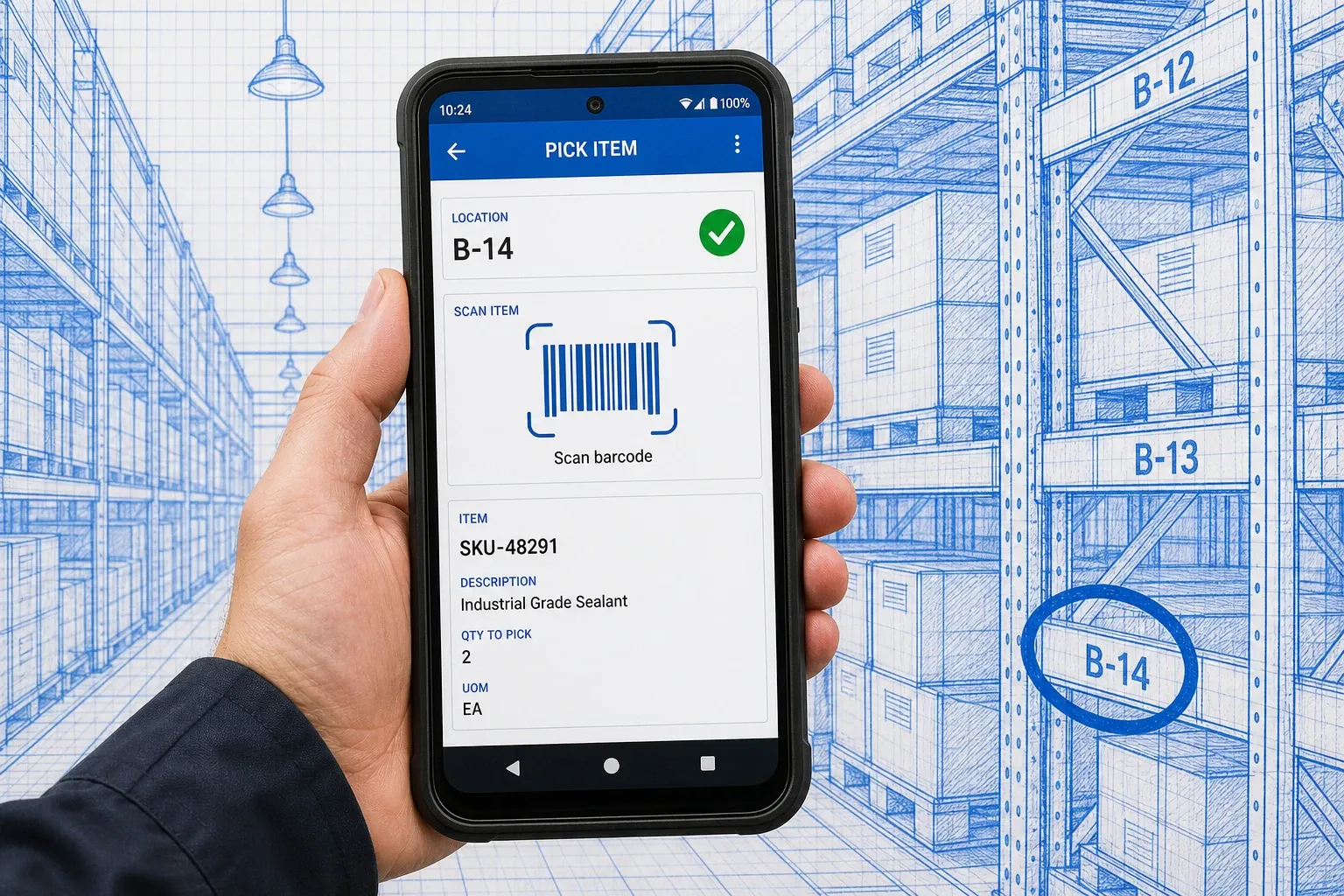
BinLogic is a warehouse-first WMS. Every unit in your warehouse moves through a barcode-verified workflow: receive, putaway, count, pick, pack, ship. The Shelfter mobile app puts all of that on Android devices your warehouse team already owns, with no specialized hardware required. Channel integrations exist to receive orders and push shipment data, but the platform is built around what happens inside your warehouse walls.
How Do Core Warehouse Features Compare?
Capability | Cin7 Core (Standard/Pro) | Cin7 Core (Advanced) | BinLogic |
|---|---|---|---|
Barcode scanning | Yes | Yes | Yes |
Bin locations | Yes | Yes | Yes |
Multi-warehouse | Yes (unlimited) | Yes (unlimited) | Yes |
Directed picking | No | Pick zones (basic) | Yes |
Walking path optimization | No | No | Yes |
Lot and serial tracking | Yes (Pro+) | Yes | Yes |
FIFO/FEFO enforcement | No | Yes | Yes |
Mobile-first floor app | Basic | Basic | Yes (Shelfter) |
Cartonization | No | No | Yes |
3PL multi-client billing | No | No | Via configuration |
The key gap is directed picking. Cin7 uses pick lists sorted alphanumerically by bin location. That works at moderate volume. At higher daily order counts, a purpose-built WMS with walking path optimization and zone-based picking delivers meaningfully faster cycle times. According to a 2026 review by LogiCatalog, Cin7's pick list approach becomes a limiting factor above roughly 500 orders per day.

Where Cin7 Wins
Multichannel order management. If you sell on Amazon, Shopify, Walmart, BigCommerce, eBay, and a wholesale EDI channel simultaneously, Cin7's native integration library is genuinely hard to match at this price point. Orders flow into a single queue. Inventory decrements in real time across every channel. Oversell risk drops because you're not managing channel stock counts in separate systems.
EDI and retail wholesale. Cin7 Omni includes native EDI for major retail trading partners including Walmart, Target, and Nordstrom. This is a meaningful differentiator for brands selling into retail in addition to DTC. EDI via Cin7 Core requires a third-party middleware like SPS Commerce, which adds cost, but Omni handles it natively.
Light manufacturing and kitting. If your warehouse assembles kits, manages bills of materials, or handles basic production runs, Cin7's manufacturing layer is built for that. This is especially useful for brands that manufacture or configure products before shipping.
B2B wholesale portal. Cin7 includes a native B2B ordering portal where wholesale customers can place orders directly against your live inventory. If you run both a DTC and a wholesale business from one system, this matters.
Demand forecasting. Cin7's ForesightAI module analyzes historical sales and can automatically generate purchase orders. For brands managing long lead times or volatile seasonal demand, having this built into the same system as your inventory record is useful.
Where Cin7 Falls Short
Implementation is complex. Cin7's own guidance recommends budgeting 4 to 12 weeks for onboarding, and multiple independent reviews document that timeline slipping when SKU counts are high or EDI setup is involved. The platform was built for power users managing multi-step procurement and manufacturing workflows. For a warehouse team that needs to scan, pick, and ship, that complexity is overhead with no payoff.
Support responsiveness is a known weakness. Reviews across G2, Capterra, and Gartner Peer Insights consistently flag slow ticket response times for standard-tier customers. One analyst described this as "a systemic issue" and recommended building a mitigation plan into any Cin7 implementation, including budgeting for either an internal system expert or a third-party implementation partner. That is a real additional cost.
Pricing can compound quickly. Cin7 Core starts at $349 per month, but the order volume caps (6,000 orders per year on Standard, 24,000 on Pro) mean fast-growing brands hit a tier bump before they expect it. Advanced warehouse features only appear in the $999 per month Advanced tier.
The global WMS market is growing at 18% annually and is expected to reach $10.89 billion by 2031, according to Mordor Intelligence. Part of what is driving that growth is brands recognizing that an IMS with a warehouse module is not the same as a purpose-built WMS when volume and accuracy requirements grow.
Where BinLogic Wins
Warehouse execution depth. BinLogic is designed around the full inbound-to-outbound cycle with barcode verification at every step. Receiving checks against the PO. Putaway rules respect velocity zones so fast-moving SKUs sit close to packing stations. Picking uses optimized walk paths. The result is fewer pick errors and faster throughput without adding headcount.
Mobile-first design. The Shelfter app runs on Android devices your team already owns. There is no specialized scanner hardware requirement (though BinLogic also works with Zebra, Honeywell, and Datalogic devices). Warehouse staff can be trained and scanning on day one, not week four.
Multi-location control. One login, one inventory number, across warehouses, dark stores, and retail back rooms. BinLogic treats every location as part of one pool. Transfers, cycle counts, and replenishment rules work across sites without a separate interface for each location.
Cycle counting without shutdowns. BinLogic supports continuous cycle counting where you spot-count any bin in roughly 20 seconds. Variances close on the floor in real time. This connects directly to the inventory accuracy practices we covered in our guide to cycle counting in 2026.
Predictable, transparent pricing. BinLogic publishes its pricing. There are no order volume caps that force you into a higher tier mid-year and no per-user fees that compound as your team grows.
How Do the Pricing Models Compare?
Cin7 Core runs from $349 per month (Standard, 5 users, 6,000 orders per year) to $999 per month (Advanced, 15 users, 120,000 orders per year). Cin7 Omni is custom-priced, typically between $999 and $2,500 per month based on integrations and users. Advanced warehouse features require the $999 per month tier.
BinLogic publishes tiered plans without order volume caps. You pay for capability, not transaction count. The Commerce Operations add-on, which enables channel integrations with 30+ channels, starts at $59 per month.
For a team with 8 warehouse staff and two sales channels, Cin7 Pro ($599/month) versus BinLogic's mid tier is a comparable investment. The difference is what you get for that investment: with Cin7, you get broad channel integration and moderate warehouse features. With BinLogic, you get deep warehouse execution and solid channel sync.
Which Teams Should Choose Cin7?
Cin7 is the better fit when:
- You sell on five or more channels simultaneously and multichannel inventory sync is the dominant problem.
- You need native EDI with retail trading partners (Walmart, Target, Nordstrom).
- You have light manufacturing or kit assembly workflows that require bill of materials tracking.
- You run a B2B wholesale channel and need a native customer ordering portal.
- You want demand forecasting built into the same system as your inventory record.
The common thread: you need broad integration breadth and are willing to invest the time and budget in a more complex implementation.
Which Teams Should Choose BinLogic?
BinLogic is the better fit when:
- Running your own warehouse and order fulfillment accuracy is your biggest constraint.
- Your warehouse team needs to be operational fast, without weeks of training.
- You process high daily pick volumes and need optimized pick paths, not static pick lists.
- You operate multiple warehouse locations or want to expand without managing separate systems.
- Predictable, transparent pricing matters and you want to avoid per-user fees or order volume caps.
BinLogic WMS is built for operations where the warehouse is the core product. If your fulfillment is the reason customers come back (or leave), that distinction matters. You can read more about how to handle multi-channel inventory management and what that layer of the stack should handle versus what your WMS manages.
Can You Use Both?
Some operations run Cin7 for multichannel order intake and channel sync while routing warehouse execution through BinLogic. Cin7 manages the order management layer: receiving orders from channels, routing them, and syncing inventory counts back out. BinLogic manages the warehouse layer: receiving, putaway, picking, and shipping. The two systems connect via API. This setup makes sense when Cin7's channel breadth is genuinely required but the warehouse volume justifies a purpose-built WMS underneath.
It is not the right answer for everyone. Managing two systems adds complexity and cost. But for operations where neither system alone covers every requirement, it is a viable architecture. Understanding what an OMS does and how it layers with a WMS gives you a clearer picture of how these system layers interact.
The Honest Conclusion
Cin7 and BinLogic are strong in different areas. Choosing between them is less about which has more features and more about which problem you are trying to solve first.
If your warehouse is running well but your inventory is out of sync across channels, Cin7 addresses that directly. If your channels are connected but your warehouse accuracy, throughput, or staff training is the bottleneck, BinLogic addresses that directly.
The mistake is buying a multichannel IMS because it includes warehouse features, then discovering six months in that those features do not run your warehouse at the volume and accuracy level you need. Or the reverse: buying a warehouse-first WMS when what you actually needed was broader channel connectivity and demand forecasting.
Know which layer of the stack is your constraint. That is the system to choose first.
If warehouse execution is the priority, BinLogic is designed for exactly that. The free trial lets you test the Shelfter app on your actual floor before committing.
Frequently asked questions
What is the main difference between BinLogic and Cin7?
Cin7 is a multichannel inventory management system (IMS) that includes WMS features. BinLogic is a warehouse management system (WMS) built for warehouse execution first. Cin7 wins on channel breadth and EDI. BinLogic wins on warehouse depth, directed picking, and mobile floor operations.
Can BinLogic and Cin7 work together?
Yes. Some operations use Cin7 for multichannel order intake and channel sync while routing warehouse execution through BinLogic. This gives you the breadth of Cin7's 700+ integrations combined with BinLogic's floor-level warehouse control. The two systems connect via API.
How long does Cin7 take to implement compared to BinLogic?
Cin7 implementations typically run 4 to 12 weeks, and the company strongly recommends engaging a certified implementation partner for SKU counts above 500 or when EDI is involved. BinLogic is designed to get warehouse teams scanning in days, not weeks, using the Shelfter mobile app on Android devices your team already owns.
Is Cin7 a real WMS or an inventory management system?
Cin7 is primarily an inventory management system with warehouse features. It supports barcode scanning, bin locations, and pick-pack-ship workflows, but it uses pick lists rather than true directed picking. Above roughly 500 orders per day, dedicated WMS platforms with optimized pick paths typically outperform Cin7's warehouse layer.
Which system is better for Shopify brands with their own warehouse?
It depends on your order volume and warehouse complexity. Cin7 works well for Shopify brands selling on two or three channels with moderate warehouse volume. BinLogic is the stronger fit when warehouse accuracy and throughput are the primary bottleneck, you run high daily pick volumes, or you have multiple warehouse locations that need tight floor control.
Run your warehouse without losing a single unit.
Binlogic is the warehouse management system for brands and retailers who run their own fulfillment. Receive, count, pick, pack and ship, with every move scanned. See it in a 30-minute demo.
Get a demo