
















What Is a Pick Path and How Do You Optimize It?
A pick path is the route an order picker takes to collect every line on one pick list and return to the depot, and optimizing it means choosing the rule that generates that route rather than redrawing one route by hand. Travel is roughly half of a picker's time, so the size of the prize is real but bounded. The shortest computable route is not automatically the best one to issue, because a route only saves time if the picker walks it, and the research is actively split on whether optimal routing survives the deviation it provokes.
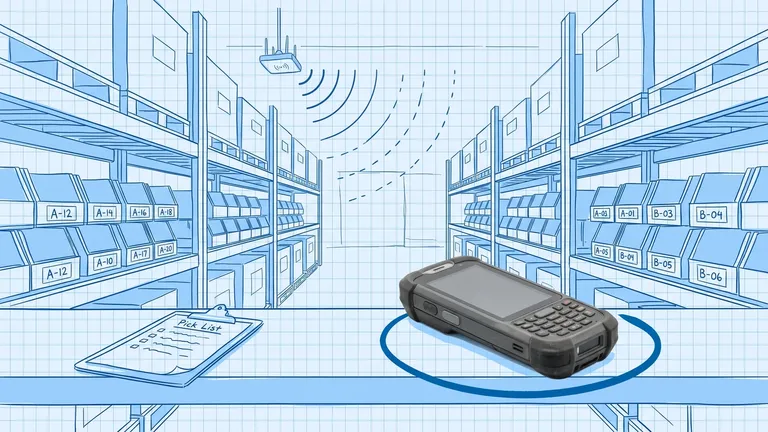
A pick path is the route an order picker takes to collect every line on one pick list. In the textbook version it starts and ends at one point, which the literature calls the depot and your floor calls induct, pack or the P and D point, though plenty of operations pick to conveyor instead. Optimizing it means choosing the rule that generates that route for every list, not drawing a better route by hand for one.
The short answer to the second half: the shortest route your system can compute is not automatically the best route to issue, because a route only saves time if the person walks it.
How much of the picking day is the pick path
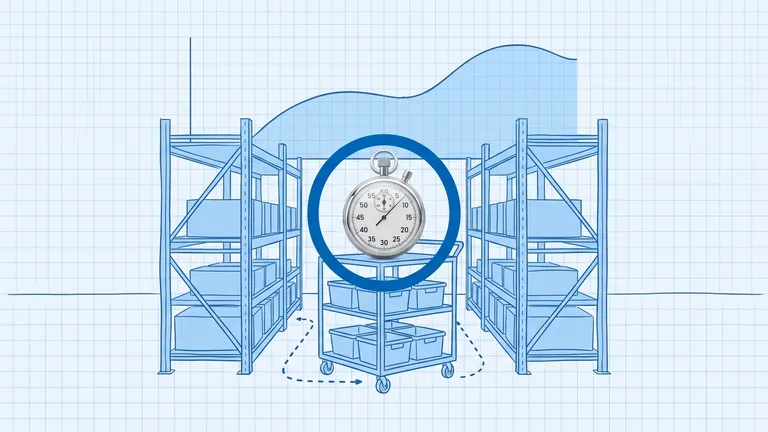
The literature review by de Koster, Le-Duc and Roodbergen puts travel at 50% of an order picker's time: "travel time is waste. It costs labour hours but does not add value."
Treat 50% as typical rather than constant: the share swings between a dense fast-pick module and a sprawling reserve area, so check yours. It still sets the ceiling. If travel is half of picking time, a routing change cutting travel by 10% cuts picking time by 5%, not 10%. Cut travel by a fifth and you buy back a tenth. Two caveats. This is a share of picking task time, not a shift: breaks, replen waits and problem-solving sit outside. And saved minutes only become money if someone re-plans headcount; otherwise they become idle time.
The formal shape of the problem
The review describes routing as "a special case of the Travelling Salesman Problem": the picker must "visit all pick locations (cities) and finally has to return to the depot."
That name usually suggests the best route is out of reach. It is not uncomputable, only intractable at scale, and for one class of layout it was solved outright. Ratliff and Rosenthal's algorithm returns an optimal route with "a dynamic-programming approach, based on the possible edge configurations of the tour along the aisles and the cross aisles", in linear time.
The binding constraint is not a tidy rectangle: the algorithm "can be applied to non-rectangular warehouses where aisles (and cross aisles) do not necessarily have the same length". It is the number of cross aisles. The algorithm addresses "the order picking problem in the case where the warehouse has two cross aisles", one at the front and one at the back. Put a cross aisle through the middle and you are outside the case it solves.
The rules your system is choosing between
Traversal, usually called S-shape, means "any aisle containing at least one pick is traversed entirely (except potentially the last visited aisle). Aisles without pick are not entered." Note the exception: the last aisle is often entered part way and backed out.
Return means "an order picker enters and leaves each aisle from the same end. Only aisles with picks are visited." In and out, like a comb.
Midpoint splits the rack: "picks in the fro[n]t half are accessed from the front cross aisle and picks in the back half are accessed from the back cross aisle."
Largest gap is midpoint with the split moved to where it does most good: pickers "enter an aisle as far as the largest gap within an aisle, instead of the midpoint", the gap being the stretch nobody has to walk. The review says it "always outperforms the midpoint method".
Combined decides aisle by aisle whether to traverse or return, and "for each visited aisle, the choice is made by using dynamic programming."
Watching will not identify your policy reliably. On a dense list, largest gap, combined and an optimal route all look like snaking, and in-and-out is often an equipment artefact, the truck parked at the aisle head because the aisle is too narrow to drive into. Many mid-market systems run no routing policy at all, just a sort by location sequence inherited from however the bins were numbered, which approximates S-shape by accident. Read the configuration and watch the floor; together they are the information.
What optimal routing is actually worth
De Koster and Van Der Poort extended the Ratliff and Rosenthal algorithm and compared optimal routes against the S-shape heuristic across three warehouse types, reporting travel time reductions of 7 to 34% and concluding that the improvement "strongly depends on the lay-out and operation of the warehouse".
Three things travel with it. That is travel time, not total picking time. It is measured against S-shape, so if you run largest gap or combined it overstates your upside. And "operation" carries as much weight as "lay-out": order profile, lines per order and pick density move week to week.
Applied to the 50% figure, the low end buys back three and a half per cent of picking time and the high end seventeen. That is arithmetic on two published averages from different studies, not a prediction for your building; it bounds the conversation, nothing more. Where you sit can be estimated before you buy, by replaying a year of your own order lines against both rules in simulation, a reasonable thing to ask a vendor for.
For buildings with more than one block, Roodbergen and de Koster developed heuristics for two or more cross aisles and used branch-and-bound to compute optimal routes as a yardstick. Optimal routes exist for those layouts; what does not exist is a fast algorithm like Ratliff and Rosenthal's, which is why commercial systems ship heuristics. Their result was that "for the majority of the instances with more than two cross aisles, a newly developed heuristic appears to perform better than the existing heuristics" — better than the other heuristics, not better than optimal, which no heuristic can beat on the same objective.
The same work flags a trap before anyone proposes cutting another cross aisle: adding them reduces travel at first, but past a point they consume space and distance of their own and handling time goes back up. Travel is rarely the real cost anyway, since a cross aisle takes out a run of pallet positions straight across the building, and storage positions are usually the binding constraint.
Why pickers ignore the route, and what the research makes of it
The review gives three reasons optimal routing is rarely used in practice, all practical rather than theoretical. An optimal algorithm "is not available for every layout". Standard algorithms cannot account for "aisle congestion", and two pickers meeting a replen truck in a one-way aisle is the ordinary way a clever route falls apart. And: "optimal routes may seem illogical to the order pickers who then, as a result, deviate from the specified routes."
Deviation is not mysterious. Pickers go off-route to build a stable pallet with heavy cases on the bottom, to skip an aisle blocked by replen, because the location was empty and the stock sat in overstock, because the cart filled up, or because the freezer gets picked last.
Two studies have tried to price that in, and they land in different places. Elbert, Franzke, Glock and Grosse built an agent-based simulation around the "empirical evidence that order pickers tend to deviate from optimal routes, putting the efficiency of these routing approaches at stake", and concluded that "even in case order pickers deviate from given routes, implementing the optimal routing policy should be the preferred option in most real-world scenarios". More recent work by De Lombaert, Leroy, Caris, Depaire and Braekers, modelling deviation in realistic warehouse settings, reports that "routing heuristics are viable alternatives to optimal routing in terms of performance" and that they impose "lower cognitive and mental demands on human operators".
Those findings are not strictly contradictory: optimal can be preferable while heuristics remain viable. But the difference in emphasis is what the usual treatment leaves out. Routing is normally presented as a ladder with optimal at the top, while the literature treats the human response to the route as a live variable that moves the answer.
The number almost nobody measures
Warehouses measure lines per hour, units per hour, pick accuracy and on-time dispatch. Very few measure whether the route was followed.
That gap is worth closing, though it does not settle which study applies to you: Elbert and colleagues found optimal preferable even under deviation, so a poor figure is not by itself an argument for a simpler rule. It tells you how much of the modelled gain you are collecting, which decides whether the next routing project is worth funding.
Measure magnitude, not a yes or no: binary compliance reports close to zero in a well-run building, because a picker who follows nine stops of eleven and swaps two counts as a failure. Extra distance walked, or stops out of sequence per tour, carries the information. If your system records the sequence it proposed alongside the sequence that was scanned, this is a query against data you already hold. If it only issues a location sort, there is no proposed route to comply with, and that is itself the finding.
Where routing sits among the other levers
Routing is coupled to where stock sits, and the review is direct about it: "a certain layout or storage assignment may perform well for certain routing strategies, but poorly for others." It also flags how thinly this is studied: "storage assignment has an impact on the performance of the routing method. However, this effect seems to be largely neglected in the literature."
The practical reading is order of operations, not size of prize: the literature does not support a claim that one returns more than the other. Re-routing a picker around badly placed stock treats the symptom, and moving the stock changes which routes are available at all, so warehouse slotting is worth settling first. Slotting is more than pushing fast movers forward: pick-face height, case weight, replen frequency and line affinity all bear on it, and velocity-to-front alone concentrates congestion where you just added traffic. Underneath both sits how the warehouse layout is designed, which fixes the ceiling on everything above.
Two limits. The single-order tour is the research's model, not what many operations run; routing a cluster cart of a dozen orders is a different problem, and what merges small scattered lists into one tour is batching, not the route. And a real building is not one block: a mezzanine, a fast-pick module, bulk and a freezer may each want a different regime.
How to optimize a pick path, in order
Read the configuration and watch the floor, treating any disagreement as information rather than error. Take a deviation baseline from your own scan data before changing anything. Settle slotting next, accepting that re-slotting resets that baseline.
Then change the routing rule, one change at a time, measuring against your own history and normalising per line and per pick density, or order mix, seasonality and new starters will swamp the effect. Then look at the building: more than two cross aisles means no fast optimal algorithm covers your layout, so what ships is a heuristic and a better one may exist.
Judge all of it on numbers you already trust. The warehouse KPIs that matter will show a real routing gain as lines per hour, or they will not show it at all.
Frequently asked questions
What is the best pick path method?
There is no single best method, and the honest answer is a range rather than a name. Optimal routing beat the S-shape heuristic by 7 to 34 per cent in travel time in one published comparison across three warehouse types, and the authors concluded the gain depends strongly on the layout and operation of the building. If yours has more than two cross aisles, no fast optimal algorithm covers that layout, so what your system ships is a heuristic.
How much time does pick path optimization actually save?
Less than the phrase suggests. Travel is about half of an order picker's time, so a routing change that cuts travel by a tenth cuts total picking time by about a twentieth. That is a saving worth having, but it caps what routing alone can deliver. Storage assignment is the other lever, and it changes how far apart the picks sit before any route is calculated at all.
How do I know which pick path method my warehouse uses now?
Watch the floor rather than the configuration screen. If pickers snake through the building, entering every aisle that holds a pick and never doubling back, that is traversal, usually called S-shape. If they enter and leave each aisle from the same end, that is the return method. The rule the system is set to and the rule your pickers actually walk are often not the same one.
Plan the route. We deliver the rest.
See how Binlogic powers last-mile logistics — routing, tracking, and the platform that turns the plan into the package on the doorstep.
Book a callback