















AI in Warehouse Management: What's Actually Useful in 2026
In a warehouse, AI is most useful where a decision is a prediction made from plenty of clean history, such as demand across a whole range, and should be measured against the classic methods that already exist for routing and slotting. The part most buyers miss is the law: for covered employers, a pick rate set by software that workers must meet can be a quota under the warehouse quota laws of California, New York, Washington and Minnesota, because those laws define a quota by what it does, not by who set it.
Much of what gets sold as AI in a warehouse is one of three things: a prediction made from your history, software that reads something a person used to read, or software that writes text. All three can be useful. The question that decides which ones earn a place on your floor is narrower than the brochures make it: is this decision really a prediction, do you have enough clean history to predict from, and does the output end up setting the pace of somebody's work?
That last question is the one buyers tend to skip, and it is the one with legal consequences. In several US states, a pick rate that workers must meet is a quota in the legal sense, and quotas come with written disclosure, records on request and protected break time. None of the statutes we read mentions algorithms or software.
What does AI actually do in a warehouse?
The jobs sort into three kinds.
- Prediction. How much of each item will sell, how many people you will need on Tuesday, which items will be ordered together next month. These are statistical forecasts, and machine learning is one way to make them.
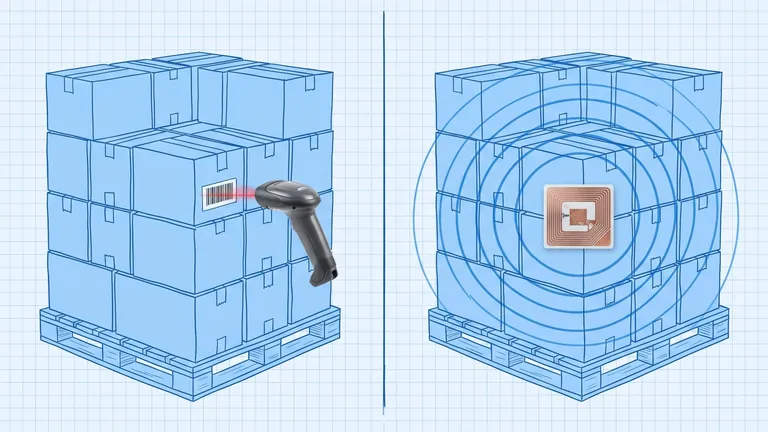
- Perception. Reading a label, a document or a shelf, so a person does not have to key it in.
- Generation. Drafting text: a supplier email, a summary of exceptions for a shift lead, a work instruction. Useful in the office and for supervisors; rarely in a picker's hands.
Robotics, such as vision-guided picking and autonomous mobile robots, also uses machine learning, but buying it is a capital equipment decision and outside the scope of this piece.
There is also a kind of problem that often gets the AI label and already has well-studied methods: optimisation. Pick routing is the clearest example, and it shows how to test any claim.
Do you need AI to plan a pick path?
You need software, but not necessarily AI. Planning the shortest route through a picking area is a version of the travelling salesman problem, which sounds hard. But for a common layout, parallel aisles with a cross aisle at the front and back and none in the middle, Ratliff and Rosenthal published an exact method in 1983 whose computing effort grows only in line with the number of aisles. Their paper reported that a 50-aisle problem required only about a minute to solve.
Simple routing rules have been studied for decades too. De Koster, Le-Duc and Roodbergen's 2007 review of order picking research describes the S-shape rule, where "any aisle containing at least one pick is traversed entirely", and the return rule, where a picker "enters and leaves each aisle from the same end." The same review reports that order picking is estimated to cost "as much as 55% of the total warehouse operating expense", and reproduces a typical breakdown of a picker's time (Tompkins et al., 2003) in which travel is the largest share. Real floors add complications the 1983 method does not cover, such as middle cross aisles, cart capacity and congestion, which is where newer tools may help. The fair question for any vendor is how much their routing beats the exact method or a simple rule on your layout, measured how.
Slotting by velocity has a classic rule behind it as well: the cube-per-order index, which the same review defines as the ratio of an item's required space to the number of trips needed to meet its demand, with the lowest-ratio items placed closest to the point where pick tours start and end. That rule ignores things like which items are ordered together and how heavy they are, so a machine-learning slotting tool may well beat it. Ask by how much, against which baseline. Our guide to warehouse slotting covers the placement side.
Where has machine learning actually proven itself?
Demand forecasting is the strongest case, and the best public evidence for it is also sobering.
The M5 forecasting competition, published in the International Journal of Forecasting in 2022, asked entrants to forecast 42,840 time series of hierarchical unit sales for Walmart, products sold across 10 stores in California, Texas and Wisconsin. The organisers reported that it was the first competition of its kind in which all the top-performing methods were pure machine-learning ones, most of them built on gradient-boosted trees, and the winning team beat the best benchmark by 22.4%, according to the preprint version of the paper.
Two other findings from the preprint matter more for a warehouse:
- Most entrants did not beat the simple method. Counting each team's final submission, only 415 teams, 7.5% of those scored, beat the top-performing benchmark, a bottom-up exponential smoothing method of the kind standard forecasting tools run out of the box.
- The advantage shrank at item level. The organisers wrote that the gains of the top methods came mainly at the top and middle of the hierarchy and were "rather limited" at the product, product-by-state and product-by-store levels.
A warehouse serving many stores and channels plans at product-by-building level, which sits within that item-level range. So expect a model to tell you more reliably how much the whole category will sell than how many of one item will ship from one building, and keep your safety stock sized for the item-level error. A vendor who shows you accuracy at the total level is showing you the easy number.
Why does AI fail on bad warehouse records?
Because it learns from them. NIST's voluntary AI Risk Management Framework puts it plainly: "The data used for building an AI system may not be a true or appropriate representation of the context or intended use." It also says that "accuracy measurements should always be paired with clearly defined and realistic test sets."
On a warehouse floor, that has concrete meanings. A demand model trained on shipments sees no sales on days the item was on the shelf but showed zero on hand, because no orders were released against it, and learns that the item does not sell; train on orders and flag stockout days. A labour model trained on scan timestamps learns from what your team scans, not from the work done between scans. A slotting model inherits every wrong dimension in the item master and every pick made from an overflow location the system does not know about.
So the first project is usually not the AI project. It is getting the record and the shelf to agree, which our piece on inventory accuracy walks through, and keeping them agreeing long enough to build a usable history. The second is setting the test: before go-live, agree a simple baseline, such as last year's same week or exponential smoothing, and a held-out period, and judge the model against both.
Can an AI-set pick rate put you under a quota law?
It can.
California, New York, Washington, Minnesota and Oregon each have a warehouse quota law. The definitions we read describe a quota by its function. New York's is typical: a work standard under which an employee is required to perform "at a specified productivity speed" or to handle "a quantified amount of material, within a defined time period", where missing it can lead to adverse employment action. California's Labor Commissioner describes the state's law the same way. In our reading, nothing in these definitions turns on who or what set the number, so a model-generated target that workers must meet, or can be disciplined for missing, looks like a quota in the same way a supervisor's target does. Washington goes further: its definition covers a standard "whether required or recommended", so a target shown as a suggestion may still count. Confirm how this applies to you with counsel.
What attaches when it does, in the laws we read:
- Written disclosure. Employees get a written description of each quota. New York requires an updated description within two business days of a change, in English and the employee's primary language, which matters if a model adjusts targets often.
- Records on request. Employees can ask for their own work-speed data. California's Labor Commissioner says employers must provide it within 21 days; Washington allows 7 business days and Minnesota 4 business days.
- Protected time. In California, Washington and Minnesota, quotas cannot prevent meal and rest breaks or bathroom use, including reasonable travel time to and from the bathroom.
- Injury programmes. Since June 1, 2025, New York requires covered employers to run an injury reduction programme whose worksite evaluations must consider risks arising "in whole or in part from an employer's use of quotas". A board-certified ergonomist must review an evaluation when an employee-led safety committee asks in writing.
Coverage depends on size and industry. New York, Washington and Oregon apply at 100 or more employees at a single warehouse distribution center or 1,000 or more across the state; Minnesota's single-site threshold is 250. These laws also define a warehouse distribution center by industry code, so headcount alone does not settle whether a site is covered.
Two further developments are worth tracking with counsel. On September 30, 2026, California's governor announced signing SB 947, SB 951, AB 1331 and AB 1883 on automated decision systems and workplace surveillance, including a protection described as prohibiting employers from relying only on AI for discipline or termination; the announcement does not say which bill contains it or when they take effect. And in the EU, the AI Act classes as high-risk AI systems intended to be used "to allocate tasks based on individual behaviour or personal traits or characteristics or to monitor and evaluate the performance and behaviour" of workers, subject to limited exemptions, and requires employers to inform workers' representatives and affected workers before using one. Under the Digital Omnibus on AI, Regulation (EU) 2026/1744, those high-risk obligations apply from December 2, 2027 rather than August 2, 2026.
How should a warehouse decide what to try first?
Run each candidate through four questions.
- Is it a prediction or an optimisation? If a classic method already exists, as it does for basic routing and slotting, ask what the AI adds over it and how that was measured on a layout like yours.
- Is the history clean enough to learn from? If the record and the shelf disagree, fix that first. A model will learn your errors faithfully.
- What is the simple baseline? Keep a seasonal-naive or exponential-smoothing forecast running beside any model, and judge both on the same held-out weeks at item-by-building level.
- Does the output set anyone's pace? If it produces a rate, a target or a ranking of people, treat it as a possible quota until counsel says otherwise: write it down, disclose it, keep the data, and log every human override.
Forecasting across a range is where machine learning has the strongest public evidence. Basic routing and slotting have classic methods that any AI tool should be measured against. Reading labels and documents can save keying time when the source data is clean. And anything that tells people how fast to work carries legal duties, whoever or whatever set the number.
Frequently asked questions
Is AI demand forecasting better than a simple forecast?
Sometimes, and mostly for totals rather than single items. In the M5 forecasting competition, built on Walmart unit sales, the gains of the top methods over an exponential smoothing benchmark came mainly at the top and middle of the sales hierarchy and were rather limited at the product, product-by-state and product-by-store levels. Most entrants did not beat that benchmark at all. Run any model beside a simple one on your own history before trusting it.
Does an AI-generated pick rate count as a quota?
It can. The warehouse quota laws we read in New York, Washington and Minnesota, and California's official guidance, define a quota as a required speed or volume of work within a period; none of the texts we checked mentions who or what sets it. A model-generated rate that workers must meet, or can be disciplined for missing, looks like a quota for covered employers. Coverage depends on headcount and industry, so confirm with counsel.
What should be in place before adding AI to a warehouse?
Accurate records. A model learns from your transaction history, so wrong item dimensions, picks from locations the system does not know about and counts that were never corrected become part of what it learns. Measure inventory accuracy first, keep a simple benchmark running beside any model, decide who can override its output and log every override, and check whether anything it produces sets the pace of people's work.
Plan the route. We deliver the rest.
See how Binlogic powers last-mile logistics — routing, tracking, and the platform that turns the plan into the package on the doorstep.
Book a callback