
















RFID vs Barcode Scanning: Which Is Better for Inventory?
RFID reads many tags at once without line of sight; a barcode scanned on a handheld is one deliberate read at a time. The 99.9 percent figure often quoted for RFID is order accuracy measured between a brand and a retailer reconciling shipments, not inventory accuracy inside one warehouse, so a site that tags its own goods and exchanges serialised data with nobody is buying a narrower benefit than the headline describes.
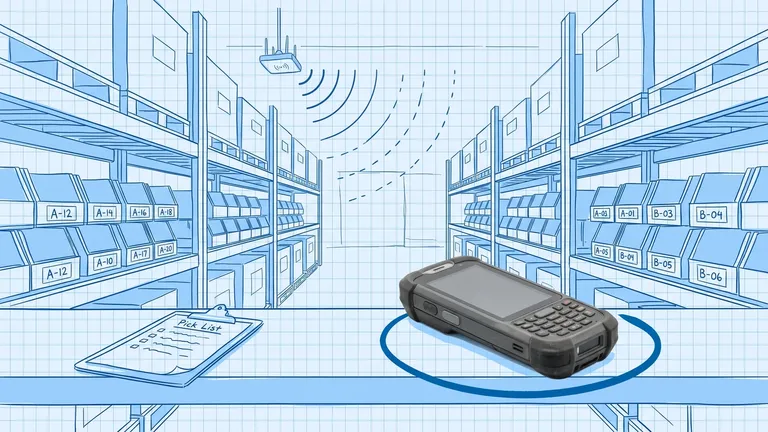
A barcode scanned on a handheld is one deliberate read: someone brings the scanner and the label into line, and the system learns one thing. A UHF RFID reader energises the area around its antennas, and the passive tags in range answer, in bulk, without line of sight. That is the main operational difference, and most of this comparison follows from it.
The commercial case needs more care. The 99.9 percent figure often quoted for RFID is order accuracy measured between brands and retailers reconciling shipments with each other. It is not a measurement of inventory accuracy inside one warehouse. If you are not exchanging serialised data with a trading partner, you are buying something narrower than that number describes, and it is worth knowing that before the quote arrives.
What actually differs between the two
Start by clearing up what does not differ, because it is the most common confusion in this comparison. Serialisation is a property of the data, not of the carrier. A barcode can identify a unique unit perfectly well: that is what a Serial Shipping Container Code on a pallet label does, and GS1 lists SSCCs among the identifiers that can be "encoded in a barcode and scanned." On the RFID side, GS1's EPC Tag Data Standard "specifies the data format of the EPC, and provides encodings for numbering schemes -- including the GS1 keys -- within an EPC." What you get is what you encode, in either carrier.
The real difference is how the read happens. Part 63 of ISO/IEC 18000 (the 2021 edition, which ISO has marked for revision) specifies the Type C air interface for the 860 MHz to 960 MHz band, and defines the "physical and logical requirements for a passive-backscatter, Interrogator-Talks-First (ITF)" system of readers and tags, with a collision arbitration scheme so many tags in the field can be separated rather than talking over each other. Passive backscatter means the tag answers by reflecting the reader's own signal rather than transmitting one of its own. Interrogator-talks-first means nothing happens until a reader energises the area. Note also that the standard sets parameters including "maximum effective isotropic radiated power (EIRP)", so confirm the hardware you buy is certified for each region you run in rather than assuming one reader travels.
Two consequences follow. Reads happen in bulk and without sight of the label, which is the advantage. And read reliability is a property of your building and your packaging rather than a number on a datasheet, because the tag is running on borrowed power in whatever conditions you supply. Auburn University's RFID Lab tells pilot teams to "Perform audits during the pilot" including read rate verification.
On the barcode side, do not over-romanticise the deliberate read either. Some scanning is fixed-position, such as inline verification on a pack line or a scan tunnel, and nobody lines anything up there. The human-confirmation argument holds for handheld picking and put-away, not for the conveyor.
Where the 99.9 percent figure comes from
The EPC/RFID Retail Supply Chain Data Exchange Study, run by the Auburn University RFID Lab with GS1 US and usually called Project Zipper, is the study behind the 99.9 percent figure. It covered 8 brand owners, 5 retailers and 11 trading partner pairs between June 2017 and July 2018.
The baseline is striking: "69 percent of inbound orders (shipped from brands and received by their retailer partners) contained errors," and in the study's summary, "Using U.P.C. data—currently the primary form of data capture and sharing—almost 70 percent of the orders contained an error somewhere in the process." Where partners "used RFID technology to optimize inventory management and reconcile product shipments," the study reports "99.9 percent order accuracy," and says those using RFID and reconciling the errors they found "saw retailer claims completely eliminated." It notes that retailers not validating 100 percent of inbound shipments "are susceptible to greater inventory inaccuracy."
Read that carefully, because two things are easy to get wrong. The 69 percent is not a scanner failure rate. Nobody's scanner misreads seven labels in ten. The study places them "somewhere in the process", measured on orders where UPC data was the medium of exchange. And "completely eliminated" is an absolute from an executive summary, which deserves the same scepticism as any other absolute.
Then read the scope, which is doing the most work of all. Every one of those numbers describes an order moving between two companies. The unit of measurement is the order, not the shelf. The study does link unvalidated receiving to retailer inventory inaccuracy, and a retailer's receiving dock is a warehouse dock; but what it measured was whether received orders matched what the brand said it shipped, not whether a building's records matched its shelves. The data is also eight to nine years old, so treat any cost conclusion drawn from it as dated.
The win is in the handoff, not in the count
The 99.9 percent figure looks like a property of the tag. Read as a process, it has four parts: the brand serialises at source, the retailer reads the same serials inbound, both sides hold data referring to the same units, and discrepancies are settled before they become a claim. That decomposition is a reading of the study rather than a finding it states, but it is hard to see which part you could remove and keep the result.
Auburn's deployment guidance points the same way. It says "tagging must occur at (or very near) the source (point of manufacture)" for the economics to work, which is a problem if you do not control your supplier's labelling. It says "Use Cases should drive technology, NOT vice versa." And it observes that companies "use flawed methods of collecting data within their own inventories" before RFID arrives at all, under the heading that "It all starts with inventory accuracy."
So the honest version for a single warehouse: if you tag your own goods at your own dock, read them yourself and exchange serialised data with nobody, you have bought bulk reading. That is a real change and it can carry a project. It is not what the 99.9 percent measured, and a business case resting on that number is resting on somebody else's process.
What the comparison usually leaves out
Two things, and they are the two an operator asks first.
Cost. This post will not quote you a tag price, because published figures are not comparable across volume, form factor and encoding, and a number lifted from a press release is worse than no number. But price the whole line, not the tag: the tag, the labour to encode and apply it if your supplier will not, readers and antennas, and a site survey. If the tag cost is a large share of a unit's margin, you want to find that out in week one, not after the pilot.
Failure modes. The architecture above has a consequence worth stating plainly: a tag that does not answer looks exactly like an item that is not there. A bulk read is good evidence of presence and weak evidence of absence, and a count needs both. It also gives presence rather than position — a read tells you a tag is in the field, not which bin it is in, unless you install the infrastructure to work that out. Whether your packaging and racking cooperate is an empirical question about your building, which is why the pilot audit matters and why it has to run on your product mix, at your dock spacing, with the awkward cases deliberately included rather than avoided.
Where each one holds its ground
RFID earns its place where the read itself is the bottleneck: high-SKU catalogues where a full count is a major exercise, item-level serialisation where you need to know which unit went where, and verification of an inbound or outbound shipment against serialised data. Verifying inbound serialised shipments against a supplier's data is the case closest to what Project Zipper measured.
Barcode scanning holds where the read is a confirmation rather than a survey, which is most of picking and put-away: a person, a unit, a moment you chose. If you are still standardising that layer, our guide to barcode scanning in the warehouse covers the ground.
Neither capture technology fixes errors that happen after the read. The study shows what verification against a partner's serialised data can catch at a handoff; it says nothing about receipts posted at the end of the shift, returns that sit uninspected or transfers recorded in the wrong direction inside your own building. Those produce wrong numbers at whatever speed your capture layer runs.
What about 2D barcodes?
The barcode side of this comparison is not standing still, but be careful about which barcode is moving.
GS1 US describes Sunrise 2027 as "a global transition from 1D UPC barcodes to 2D barcodes, like QR codes," with retailers expected to "Install optical scanners that are Sunrise-capable to read 2D barcodes and extract the GTIN at POS" in the first phase, and GS1 frames the destination as a retail vision in which "each product will have a single multipurpose 2D barcode." GS1 US notes the approach allows "updating 2D barcodes with additional data, such as product variants and production or expiration dates."
That is a point-of-sale readiness programme, not a warehouse capture change, and the distinction matters. It does not promise that goods arriving at your dock will carry a data-rich symbol on any particular date, and your logistics labels are a separate question from what is printed on the consumer item. If richer data on the item is the thing you actually want, it is worth knowing this is moving before you buy portals to get it — but do not plan a receiving process around it.
How to decide without the pilot deciding for you
Measure your current accuracy the way you intend to measure it afterwards, so the before and after answer the same question. Our explainer on what inventory accuracy is and how to measure it sets out the method.
Then: name the use case before the technology. Find out who tags, and reprice if the answer is not your supplier. Ask who else reads the serialised data you would create; if the answer is nobody, cross the handoff benefits off. Get the whole cost line, not the tag price. Audit read rates in your own building rather than accepting the demo.
And run a reason-coded cycle counting programme first. Counting alone tells you that you have variance and where; coding the reason is what tells you whether the problem is capture or behaviour. If it is behaviour, a faster reader will not fix it.
Frequently asked questions
Is RFID more accurate than barcode scanning?
That question hides the number most often quoted. In the Auburn and GS1 US study, partner pairs using RFID to reconcile shipments reached 99.9 percent order accuracy, while working from UPC data almost 70 percent of orders carried an error somewhere in the process. Both figures describe orders moving between two companies, not shelves inside one building, and the study places the errors somewhere in the process, not in a scanner misread rate.
Do RFID tags replace barcode labels?
Not usually. Tagging adds a capture layer rather than removing one: anyone downstream without a reader still needs a label they can scan, and a scan remains a deliberate confirmation by a person at a moment you choose. GS1 identifiers can be encoded in a barcode or in an EPC, so the same numbering can sit on both. Plan and budget for running both.
When is RFID not worth it for a warehouse?
When you cannot tag at or near the point of manufacture, when nobody downstream reads the serialised data you create, or when your errors come from how your own team posts transactions rather than from reading. A floor that posts receipts late, leaves returns uninspected or counts against a flawed method will reproduce all of that at higher speed. Fix the method first, then decide.
Run your warehouse without losing a single unit.
Binlogic is the warehouse management system for brands and retailers who run their own fulfillment. Receive, count, pick, pack and ship, with every move scanned. See it in a 30-minute demo.
Get a demo