
















Cross-Docking Explained: When Freight Should Skip the Rack
Cross-docking moves freight from an inbound trailer to an outbound trailer without putting it into storage first. It pays when the outbound destination is settled before or at the moment the freight lands, and when inbound and outbound timing can be held close together. Most lanes fail on inbound data, outbound trailer availability and scheduling rather than on the number of dock doors.
Cross-docking means moving freight from an inbound trailer to an outbound trailer without putting it away first. No rack location, no pick face, no second handling a week later. It works when the freight's outbound destination is settled by the time it hits your floor, and when you can get an outbound trailer under it.
That is the decision. Most writing on cross-docking treats it as a building; it mostly is not. It is a bet that your inbound information and dock scheduling are good enough for freight to cross the floor in hours instead of days.
What is cross-docking?
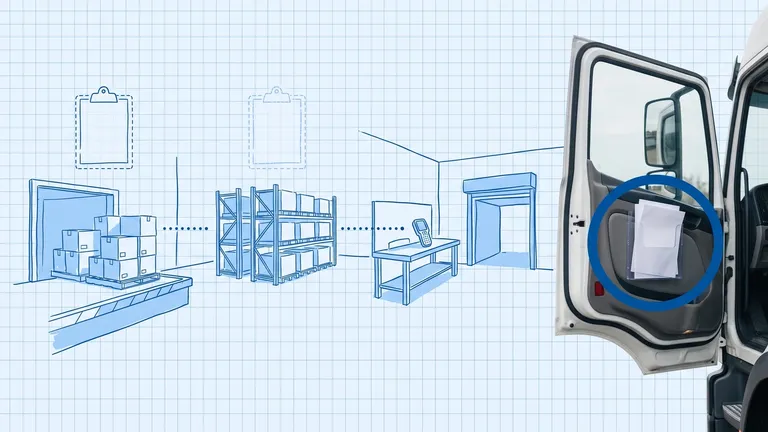
Strip a receipt down and it runs roughly: check in, unload, verify against the purchase order or advance ship notice, disposition damage, put away, replenish, pick, pack, stage, load. Cross-docking cuts out the putaway, the replenishment and the pick, replacing them with one move across the floor, or with a single sort when freight has to be broken down and rebuilt by destination.
The saving depends on the operation. In a brand's own warehouse it is mostly handling and time: fewer touches, each with its own travel and its own chance of going to the wrong place. In retail flow-through the headline saving is inventory and cube, because stock that never rests is stock you never financed or stored.
The cost is that you have given up your buffer. In a normal warehouse a short delivery is absorbed: the shelf has stock from last week and the order still ships. It is still written on the delivery receipt before the driver leaves and worked as an exception that shift, but the customer never sees it. On a cross-dock lane there is no shelf, so a short at nine in the morning has to be met with a decision by early afternoon: fill from rack, roll it to the next departure, or short-ship and tell the customer. Lanes that work have that decision written down before they open.
When should freight skip the rack?
There are two patterns, and confusing them causes most arguments about what cross-docking really is.
In pre-distribution cross-docking the supplier already knows the final destination and labels the freight for it. The pallet arrives pre-allocated and your job is to move it to the right outbound door. In post-distribution cross-docking the freight arrives unallocated and you decide where it goes at receipt, against live orders. Grocery and general merchandise run enormous volumes this way. Both are cross-docking; the second demands more of your systems, because the allocation happens on your floor and your clock.
Either way, the conditions that make a lane pay are similar. The outbound demand must be known no later than receipt. The inbound must be predictable enough to schedule against, since a load that arrives four hours late will miss a departure unless you built slack in. And the handling has to be worth it: pallet-through moves are the easy case, while break-bulk sorting into destination pallets is harder but still pays, which is exactly why every less-than-truckload terminal on earth is a cross-dock.
Where it does not pay: slow movers, stock held deliberately to absorb supplier unreliability, and anything whose destination is not known for days. Steady volume makes a lane easier to staff, though promotional and seasonal pushes are often cross-docked precisely to keep a spike out of the rack.
What has to be true before the first pallet moves
Cross-docking is an information and scheduling problem wearing the costume of a materials-handling problem.
You need to know what is on the vehicle before it arrives, at pallet or carton level. That is what an advance ship notice is for, and it is why the pallet label matters. GS1 defines the Serial Shipping Container Code as an identifier for a logistic unit, which can be "any combination of trade items packaged together for storage and/ or transport purposes; for example a case, pallet or parcel." It is 18 digits, built from an extension digit, a company prefix, a serial reference and a check digit, and GS1 notes that information about the unit "can be communicated via a Despatch Advice or Advanced Shipping Notice (ASN) prior to the logistic unit's arrival."
Be precise about what that buys. Scanning the SSCC at the door tells you which logistic unit has arrived and which shipment line it belongs to, and GS1 says it will "speed up the receipt of goods as well as the subsequent invoicing process." It does not tell you where the pallet goes next. Outbound routing comes from your own allocation, unless the supplier labelled to the final destination. Identification and routing are two different problems and only one of them is solved by the supplier. If you are setting labels up, binlogic.io hosts a free SSCC-18 label generator and an explainer on how the GS1 company prefix works.
The second requirement is control of the inbound, which is not the same as asking nicely. On prepaid supplier freight the supplier's carrier decides when it arrives. The levers that work are commercial: collect terms so you control the transport, a routing guide, a managed inbound programme, delivery windows backed by scorecards.
The third is that your warehouse system can post a cross-dock receipt at all. Plenty of systems will not allocate stock to an outbound order until a putaway is confirmed. That single configuration detail blocks more first lanes than any amount of floor space.
The "never touches the floor" picture is misleading
The standard description of cross-docking is that goods move straight from inbound to outbound and are never stored. Almost every working lane has a staging area anyway.
The reason is dull and physical: the outbound trailer is frequently not at the door when the inbound arrives, and the two timetables rarely line up to the minute. Freight has to wait somewhere. The design question is not how to eliminate staging but how large the footprint is, where it sits, and how long a pallet may occupy it before somebody intervenes. It should be marked-out floor away from the dock apron: staging in front of the doors blocks the approach, wrecks load sequence and eats required clearances.
The research points the same way, with a caveat worth stating. An open-access systematic review of cross-docking studies published between 2015 and 2020 examined how 25 case studies treated temporary storage: only two modelled none at all, while thirteen modelled a staging area with a capacity limit and ten allowed unlimited storage. That describes what researchers assume rather than a census of real buildings. It is still telling that the models written to describe the ideal case almost never describe a lane with nowhere to put a pallet.
The same review is blunt about how little of this work has been tested on a real floor. Of the 25 studies, two reached an implementation: one gathered eight days of operating data, the other ran a simplified version for eight weeks. It quotes an earlier assessment that "a significant share of the quantitative studies use modelling constraints and performance measures that do not adequately reflect real-world industry practice." The evidence also leans toward sectors where freight arrives pre-allocated, with retail accounting for eight of the cases and automotive five. Treat the literature as a source of structure, not a promise about your building.
What it costs when the timing slips
Cross-docking converts a storage problem into a scheduling problem, and scheduling problems show up as trucks waiting.
Sequencing is worth real money. A 2025 study of inbound truck scheduling at a sortation-style cross-dock terminal found that dynamic rescheduling improved workload balance across outbound positions by roughly ten and twelve per cent against first-in-first-out and random sequencing, and cut average truck waiting time by seventeen and eighteen per cent. Read that narrowly: it is one modelled terminal with conveyor chutes, and the building's configuration was held constant, so it says nothing about whether more doors would help. What it does show is that the order in which you bring vehicles to doors is itself a lever.
It also flags a tension. Minimising truck waiting time and keeping work balanced across outbound positions pull against each other, because unloading as fast as possible piles work onto whichever outbound lane is already busiest. And resequencing assumes you can park a trailer. On live unloads with no drop yard, the trailer at the door is the one you unload, and making it wait starts a detention clock.
Cross-docking food and anything on a traceability list
Speed does not reduce your record-keeping.
Under the FDA's Food Traceability Rule, businesses that manufacture, process, pack or hold foods on the Food Traceability List must keep records of key data elements tied to critical tracking events, subject to the rule's exemptions. Receiving is defined as an event where food "is received by someone other than a consumer after being transported... from another location", and shipping as an event where food "is arranged for transport... from one location to another location". Cross-docking is not carved out as a separate event type, so freight that lands and leaves the same afternoon has still been received and still been shipped.
Be careful how you describe the timing. The compliance date in the rule itself has not changed; Congress directed the agency not to enforce the rule before July 20, 2028, and the FDA has said it intends to comply with that direction. Non-enforcement is not the same as an amended date, and a customer audit or a contract warranty may not treat it as such.
Rotation still has to hold, and cross-docking is where it quietly breaks. Under FEFO the nearest-expiry stock ships first, so the risk on a lane is the opposite of the obvious one: you flow a fresh pallet straight out of the door while older stock ages in the rack. Check date codes on freight you never open, and check them against whatever minimum remaining shelf life your customer specifies on arrival, because a load rejected at their dock for short coding is the expensive version of this mistake.
How to start with one lane
Pick one supplier and one destination with steady volume. Ask for an advance ship notice with pallet-level identifiers, then measure it before you rely on it: does the notice land before the truck, do the codes on the pallets match its lines, are the counts right. An unvalidated notice generates mis-ships.
Run the lane as an exception with a named owner, through at least one busy period: peak is the only time the footprint and the coupling get tested. Measure the share of pallets that cross without being opened, the peak number of pallets in the staging footprint at once rather than the average dwell, on-time outbound departure against trailer cut, and labour hours per pallet against your normal putaway and pick baseline. That last one is the business case.
If pallets keep getting opened, look upstream at supplier data, but look at your own requirements too: customer compliance labels, damage checks, quality holds and mixed-destination pallets all force a pallet open regardless of how good the notice was. If the staging peak keeps climbing, your inbound and outbound timetables are not as coupled as you assumed. Both are cheaper to learn on one lane than across a building.
Frequently asked questions
Do you need a special building to cross-dock?
Not usually. Purpose-built terminals are long and narrow with doors on opposing walls because that shortens travel, but plenty of operations run a lane or two inside an ordinary warehouse. What you do need is door time rather than door space: an outbound trailer spotted when the inbound lands, somewhere to stage that is not the dock apron, and yard room. Those bind more often than square footage.
What happens when the advance ship notice is late or wrong?
You need a decided fallback before you open the lane, because this will happen. The usual answer is that the load reverts to a normal receipt: it gets put away, and the outbound demand it was meant to cover is filled from stock or short-shipped with notice. Lanes get into trouble when there is no agreed fallback and the floor improvises one under time pressure.
Does cross-docking remove the need for inventory records?
No. Freight that crosses your floor has still been received and still been shipped, so counts and exceptions are recorded either way. In lot-controlled categories such as food and pharmaceuticals, lot codes and date codes have to be captured too, and for food on the Food Traceability List receiving and shipping are both recordable events under the FDA rule however briefly the goods sit.
Run your warehouse without losing a single unit.
Binlogic is the warehouse management system for brands and retailers who run their own fulfillment. Receive, count, pick, pack and ship, with every move scanned. See it in a 30-minute demo.
Get a demo