















Put-Away Best Practices for High-Volume Warehouses
Good put-away means the system only offers locations that can safely take the load, then chooses among them by rule, and the pallet is not counted as stored until the location is scanned. Random storage saves space and class-based storage saves travel, but both only work on the locations that pass that first check.
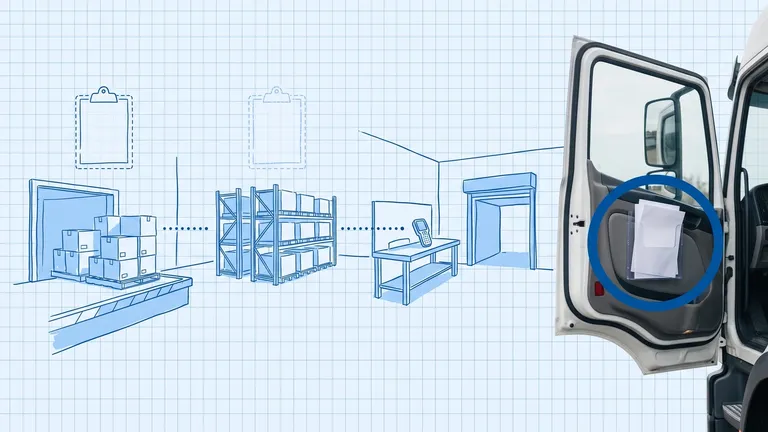
Put-away is the step between the receiving dock and a location that can be picked from. When it goes wrong, it shows up days later as a short pick, a failed count or a forklift driver hunting the aisles.
The short version of good practice: only offer locations that can safely take the load, choose among those by a rule rather than by habit, scan the location to confirm, and do not count the stock as stored until that scan happens.
What does put-away actually decide?
Every put-away answers four questions: which location, whether the pallet goes to reserve or straight to a pick face, how the load gets there safely, and when the record says it is there. The last one is a common cause of inventory errors, because a pallet that is physically in one location and recorded in another is lost until somebody stumbles on it.
Should put-away be random, fixed or by velocity?
Warehouse research describes a small set of storage assignment policies, and each trades space against travel.
- Random storage. A pallet goes into any eligible empty location. A widely cited 2007 review of order-picking research by de Koster, Le-Duc and Roodbergen says random assignment "results in a high space utilisation", at the expense of longer travel.
- Closest open location. The review defines it simply: "The first empty location that is encountered by the employee will be used to store the products." It notes that closest open location and random storage perform similarly when products are moved by full pallets only.
- Dedicated storage. Each product has a fixed home. The review's objection: "a location is reserved even for products that are out of stock", so space utilisation "is lowest among all storage policies."
- Class-based storage. Products are grouped, usually by how fast they move. "Each class is then assigned to a dedicated area of the warehouse," and "Storage within an area is random." In automated storage systems, Hausman, Schwarz and Graves (1976) found "significant reductions in crane travel time (and distance) are obtainable from turnover-based rules."
Our recommendation for most busy floors is class-based: fast movers in the zones closest to the pick and ship flow, slow movers further out, random within each zone. How to set those zones is a slotting decision; see what is warehouse slotting.
What makes a location eligible for this pallet?
The research assumes a set of eligible empty locations and leaves eligibility to the operator. On a real floor, eligibility is decided before any distance rule gets a vote, and much put-away advice skips it. The sources that decide it:
- Rack capacity. OSHA's warehousing guidance says to "Ensure that storage shelving and rack load capacities are not exceeded." The Rack Manufacturers Institute describes load plaques as "a constant reminder of the rated load capacity of the rack," and warns that changing racks to "a configuration that was not considered in the design may create an unsafe condition."
- Floor and platform load. Under 29 CFR 1910.22, "each walking-working surface can support the maximum intended load for that surface."
- Sprinkler clearance. OSHA's sprinkler rule says "The minimum vertical clearance between sprinklers and material below shall be 18 inches (45.7 cm)," for sprinkler systems "installed to meet a particular OSHA standard." Most warehouse systems are designed to the local fire code, which can require more, so use your building's figure.
- Stable stacking. For material stored in tiers, 29 CFR 1910.176(b) requires it to be "stacked, blocked, interlocked and limited in height so that they are stable and secure against sliding or collapse." A pallet with broken boards or failed wrap is not ready for any location.
- Weight placement. OSHA's guidance says to "Place heavier loads on lower or middle shelves."
- Damage. If a rack is damaged, OSHA says to "immediately isolate the affected area," and RMI says the owner's first priority is to "immediately isolate the affected portions of the rack."
Our reading of these together: "open" is a filter, not a distance. A location is open for a given pallet only if the weight is within capacity, the height keeps the required clearance under the sprinklers, the location is not isolated for damage, and (for lot-controlled goods) it will not mix lots. Only then should the system choose the closest or the right-zone location. The space-versus-travel trade-off in the research applies to whatever survives that filter.
Two cautions. First, rack capacity on a load plaque is usually stated per beam level and per bay, not per pallet slot, so a check that only looks at the single slot can pass every pallet and still overload the level. Check the level total too. Second, hazardous goods such as flammable liquids and aerosols have their own storage rules and are outside the scope of this guide; they belong in their own filter.
In system terms, every location needs a maximum height and a status that can be set to blocked, every beam level needs a capacity, and every inbound pallet needs a real height and weight. Pallet heights change by supplier and by shipment, so check the height of each inbound pallet against a gauge or a marked post, as OSHA's materials handling guide suggests with "stripes to indicate maximum stacking heights", rather than trusting a master record.
How do you confirm the pallet went where the system says?
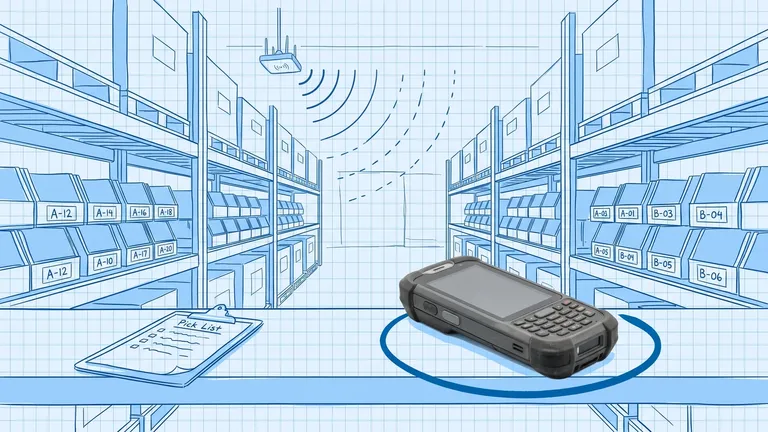
Scan the location, not just the pallet. If the operator only scans the pallet and then presses "done", the record says the stock is where the system told the operator to put it.
GS1, the barcode standards body, provides for this. Its guidance says a Global Location Number "can also be physically marked with a barcode at a location, for example on a dock door or on a storage location," using Application Identifier (414). GS1 also defines an extension component for sub-locations such as "warehouse zones, individual shelves or service points." In practice most warehouses use their own location codes; that works as long as every location has a scannable label whose code matches the system.
On the pallet side, the Serial Shipping Container Code (SSCC) on a GS1 logistic label "remains the same for the life of the logistic unit," according to GS1 Australia, and GS1's logistic label guideline says that when the SSCC is scanned "it should match the information in the Despatch Advice / ASN." For scanning hardware and workflow, see barcode scanning for warehouse inventory.
Three rules make the scan meaningful:
- The system rejects a location scan that does not match the instruction. An operator override is allowed with a reason, but the system re-runs the eligibility check on the scanned location before accepting it, and repeat overrides go to a supervisor.
- Stock is not available from a storage location until the location scan is confirmed.
- Staging and put-away lanes are real, scannable locations. That lets urgent orders and cross-dock freight be picked from staging on purpose, and lets you see how long stock waits there.
Should a pallet go to reserve or straight to the pick face?
At high volume this is often the biggest choice put-away makes. If the pick face for a product is low and the inbound pallet fits, putting it away straight to the pick face saves a second move later. If it does not fit, the pallet goes to reserve and a replenishment move follows. Our recommendation: let the put-away rule check the pick face first for fast movers, and send the pallet to reserve only when the pick face cannot take it.
How do you keep lots and dates apart?
If you receive goods with batch numbers or best-before dates, put-away is where lots get mixed or kept apart. GS1's logistic label guideline says "Only one batch number can be put on a logistic label," and when a pallet carries several best-before dates, it tells shippers to show the earliest one for FIFO purposes. So a mixed pallet can look single-lot from its label. Flag or break down mixed pallets at receipt, before put-away.
For human food facilities covered by 21 CFR Part 117, section 117.93 requires storage "under conditions that will protect against allergen cross-contact," as well as against contamination and deterioration. That is a separation rule: which products may sit next to or above which.
Keeping one lot per location is a different matter: it is our recommendation for traceability and recalls, not a requirement of that regulation. It costs some space, the same way dedicated storage does, but in single-deep selective rack it means a pick by lot or expiry never has to dig. In drive-in, push-back or floor-stacked lanes, the lane is the location, and its depth decides the rotation, so keep each lane to one lot. For how rotation rules work once stock is stored, see FIFO vs FEFO stock rotation.
How do you keep put-away safe at volume?
High-volume put-away is mostly forklift and reach-truck work. Under 29 CFR 1910.178(l), the employer must ensure "each powered industrial truck operator is competent to operate a powered industrial truck," and the required training covers "Pedestrian traffic in areas where the vehicle will be operated." Paragraph (o) is short and blunt: "Only stable or safely arranged loads shall be handled" and "Only loads within the rated capacity of the truck shall be handled." It adds that "long or high (including multiple-tiered) loads which may affect capacity shall be adjusted." A pallet that is fine on the floor is not automatically fine at the top beam, so check the truck's rated capacity for the height you are storing at.
Under 1910.176(a), where mechanical handling equipment is used, "sufficient safe clearances shall be allowed for aisles." A staging pallet left in an aisle because the put-away lane is full is a safety problem first.
For hand put-away to shelving, the NIOSH lifting equation uses a load constant of "23 kg or 51 lbs," described as the maximum recommended load "to be lifted under ideal conditions." Reaching, twisting and lifting above the shoulder lower the recommended limit, and OSHA's guidance is consistent with that: heavier loads on lower or middle shelves.
A put-away checklist for a high-volume shift
- Every location has a scannable label, a maximum height and a status (open, blocked, damaged); every beam level has a capacity.
- Every inbound pallet's height is checked against a gauge or marked post, and its weight is checked when it differs from the product record.
- Receiving moves stock into a scannable put-away lane, not straight into a storage location.
- The put-away rule filters by capacity, height, status and lot first, checks the pick face for fast movers, then picks the closest location in the right zone.
- Operators scan the pallet and the location; overrides need a reason and pass the same eligibility check.
- Damaged rack is isolated immediately and its locations are blocked in the system before the next put-away.
- The put-away lane is reviewed at the end of every shift: anything received but not stored is put away or reported, and the time it waited is recorded.
It is the difference between a system that knows where the stock is and one that knows where it hoped the stock would go.
Frequently asked questions
What is the difference between random and class-based put-away?
Random put-away stores a pallet in any eligible empty location. A 2007 review of warehouse order-picking research says this uses space well but lengthens travel. Class-based put-away groups products, usually by how fast they move, gives each group its own area, and stores randomly inside each area. Research on automated warehouses found turnover-based rules cut travel significantly. For most busy floors we recommend class-based zones with random storage inside them.
Should put-away operators confirm the location by scanning it?
Yes. If the location is not scanned, the system records where it told the operator to go, not where the pallet went. GS1 allows a storage location to carry its own barcode, and most warehouses use their own location codes on labels. A pallet put in the wrong slot becomes a stock discrepancy at the next pick or count, and nobody can say when it happened. Scan the pallet, then the location.
How much clearance does stored material need below sprinklers?
OSHA's sprinkler rule, 29 CFR 1910.159(c)(10), sets a minimum of 18 inches (45.7 cm) between sprinklers and the material below, but it applies to sprinkler systems installed to meet an OSHA standard. Most warehouse sprinkler systems are designed to the fire code your jurisdiction adopts, which can require more. Ask your sprinkler designer, fire marshal or insurer for your building's figure before setting maximum location heights.
Run your warehouse without losing a single unit.
Binlogic is the warehouse management system for brands and retailers who run their own fulfillment. Receive, count, pick, pack and ship, with every move scanned. See it in a 30-minute demo.
Get a demo