
















What Is Omnichannel Fulfillment and How Does It Work?
Omnichannel fulfillment means filling orders from your website, marketplaces, wholesale accounts and stores out of one shared inventory pool, with each order line sent to the location best placed to fill it. Choosing that location is a software decision. The floor problem is keeping one count true when the same product leaves as single units, sealed cases and store transfers.
Omnichannel fulfillment means filling orders from every place you sell, whether your own website, marketplaces, wholesale accounts or your stores, out of one shared pool of inventory, with each order line sent to the location best placed to fill it. This post is about what that does to the warehouse floor, where one building now runs several kinds of work against the same stock.
Deciding which location ships is a software problem. The floor problem is keeping one count true when the same product leaves the building as a single unit in a parcel, as a sealed case on a pallet, and as a transfer to a store.
What is omnichannel fulfillment, in plain terms?
Three ideas sit underneath the term:
- One inventory pool. The channels sell against the same stock record rather than each holding its own slice. A unit sold on a marketplace is a unit the website can no longer promise.
- Locations are shared across channels. A warehouse, a store or a 3PL can each fill orders from more than one channel, within the rules you set.
- A decision per order line. Something, whether rules in the storefront, an order management system or a person, picks the location for each item, which is how one order can ship from two places. The floor sees only the result.
Multichannel is the narrower idea: you sell in several places. Plenty of multichannel sellers still fulfill each channel from its own stock. Omnichannel fulfillment begins where the stock stops belonging to a channel. The inventory side of that is covered in multi-channel inventory management.
Commerce platforms model it this way. In Shopify, apps that physically stock inventory are treated as locations, including "third-party logistics services, and custom fulfillment services", and order routing rules "determine the locations to use to fulfill each item in a customer order." Routing only matters once there are two or more fulfillment locations; with one, Shopify says, "every order is assigned to that location".
Why does it matter if most of my growth is online?
Because across US retail as a whole, most sales still happen offline. The US Census Bureau's quarterly report put e-commerce at 17.1% of total US retail sales in the second quarter of 2026, seasonally adjusted. E-commerce grew faster, up 12.2% (±0.9) on a year earlier against 6.7% (±0.5) for all retail, but physical retail still accounts for the large majority of sales. One caveat on the source: Census notes that, as of September 28, 2026, that report no longer contains its most up-to-date estimates, and revised figures are due in the third-quarter release on November 19, 2026.
So a brand selling online, wholesale and through stores has an omnichannel problem whether or not it uses the word: the stock that sells online is also the stock a wholesale buyer ordered and a store expects on next week's truck.
How does omnichannel fulfillment work, step by step?
Strip away the vocabulary and an order goes through six steps:
- Capture. The order arrives from a channel: a storefront, a marketplace, an EDI purchase order or a store request.
- Commit. The units are set aside so no other channel can sell them. Shopify calls these units committed, which covers "units in an unfulfilled order, reserved in a draft order, or in a transfer that's marked as ready to ship."
- Assign. A location is chosen for each line. This is the routing decision, the part software makes visible.
- Release. The order reaches the floor as work: a pick task, usually grouped into a wave or batch, which may in turn trigger replenishment of the pick face.
- Pick, pack and label. The product leaves its location in whatever form the channel needs.
- Confirm. The shipment, handoff or receipt is recorded: on-hand drops at the shipping location, the commitment is cleared, and a transfer is added to the receiving location's stock.
Steps 1 to 3 happen in software. Steps 4 to 6 happen on the floor.
What changes on the warehouse floor?
The building stops doing one job. The same product can now leave in four forms, three of them through the warehouse door and one from a store shelf:
Order type | What is picked | What goes on it | What has to be recorded |
|---|---|---|---|
Website or marketplace parcel | Single units, often mixed products | Carrier label | Ship confirmation and tracking back to the channel |
Wholesale or big-box order | Full cases from case-pick locations, or full pallets | Carton and pallet labels carrying an SSCC, to the buyer's requirements | A ship notice matching each SSCC to its contents, where the buyer's terms require one |
Store replenishment | Cases or units for each store | Transfer paperwork | Shipped at the warehouse, received at the store |
Store pickup or ship-from-store | Units from the store's own shelf | Pickup slip or carrier label | Handoff or shipment, against the store's count |
The second row is where many direct-to-consumer brands meet a different set of rules. GS1 US describes the GTIN-14 as the identifier for "trade item groupings (e.g., case of a product or set pack)" and says it is "NOT intended for POS use". The same product can therefore carry one number as a sellable unit and another as a case. GS1 defines the SSCC as the identifier for a logistic unit, "for example a case, pallet or parcel", and GS1 US notes that GTINs are carried in EDI messages between trading partners, including advance ship notices. A floor that has only packed parcels may never have had to produce any of that.
Store replenishment is a transfer, not a sale. In Shopify's example of one store sending 90 units to another, those units show as Incoming at the receiving store, and incoming stock "isn't available to sell until it's been received at the location." That is correct while the truck is moving. The cost comes when the store is slow to scan the delivery in, and sellable units sit on its shelf invisible to every channel.
Where can omnichannel fulfillment break on the floor?
Routing failures are real: the wrong location ships, a split costs a second box, a delivery promise is missed. But because they are software decisions, they leave a record you can query. One floor failure that we think gets too little attention leaves no record at all: the unrecorded case break. What follows is our reasoning about how it plays out, not a measured rate.
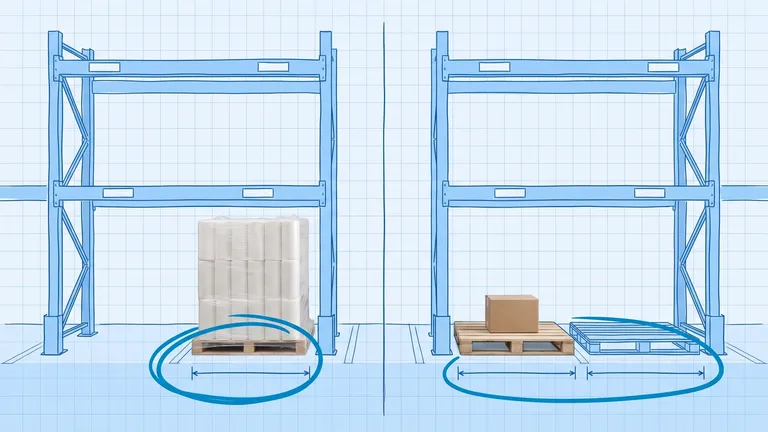
Parcel orders are picked as single units from a pick face. Wholesale orders are picked as full cases. When a pick face runs dry mid-shift, someone opens a case meant for case picking to keep parcels moving. If that break is recorded, the case location drops by one case and the pick face gains the units that were in it, and every number agrees.
If it is not recorded, the system still shows that case in its location and too few units on the face. Where the case and the unit are held as separate items, as happens when a case pack is listed as its own product, the case item now reads one too high and the unit item one case short. Either way, the next wholesale order can be allocated a case that no longer exists. If the face quantity drives replenishment or what the channels can sell, the item can also look low while loose units sit on the shelf.
A good inventory-control team checks a variance against the product's other locations and will often find the pair. But if counts are reconciled location by location, or the case and the unit are separate items, the overage on the face and the shortage in case storage can look like two unrelated problems. They are one event.
The first fix is to replenish pick faces before they empty, with minimum and maximum levels or demand-based triggers. The second is to make breaking a case a handheld transaction, scanning the case and then the face, and to back that with frequent counts on fast movers so an unrecorded break is caught within days rather than at the next wholesale order.
Do I need to hold stock back for each channel?
Sometimes, and when you do, the hold belongs in the system, not in someone's memory. Shopify, for example, separates committed units, held for an unfulfilled or draft order, from unavailable units, held for reasons such as "damaged, quality control, or safety stock" and described as "stocked at your location but isn't available to sell." Setting stock aside for a wholesale order that ships next week is a legitimate use of the first. On the floor, put the hold on the location or the pallet record, or move the stock to a hold location, so that no pick task is ever directed to it. For the logic of buffers across channels, see how to prevent overselling across multiple channels.
How do I set up a warehouse for omnichannel fulfillment?
Start with the record, then the floor:
- Check the case quantity in the item record. If it does not match what the supplier actually ships, every unit-to-case conversion downstream is wrong.
- Track stock by location and by unit of measure. A unit, an inner pack and a case are different things to count, even when they are the same product.
- Separate pick faces, case-pick locations and reserve. Parcels pick units, wholesale picks cases or pallets, and replenishment moves stock between them as a recorded move the system directs.
- Make case breaks a scanned transaction, and replenish faces before they run dry so breaks are rare.
- Release work by order type. Parcel orders, wholesale orders and store transfers have different cut-offs and pack stations. Release them separately and give pallet builds their own staging lanes so they never block the parcel line; wave picking covers one way to group the work.
- Label in the order the freight is built. Print each carton's SSCC label at pack from the scan that confirms its contents, build the pallet by scanning those cartons onto a pallet SSCC, and send the ship notice from the ship-confirm scan, so the notice describes exactly what is on the truck.
- Count each location, and reconcile transfers. A transfer shipped and never received sits in transit in the system. If it arrived unrecorded, the store's next count shows an overage; if it was lost, only a report of aged in-transit stock will surface it.
- Route returns into the same record. Returns come back through every channel too, and each one has to land in the shared record before the unit is sellable again.
What should I measure?
Measure by order type, not only by site: on-time shipping for parcels; fill rate, on-time-in-full and ship-notice accuracy for wholesale; and received against shipped for store transfers. A building can hit its parcel target while short-shipping a wholesale order from a case that was opened last Tuesday and never recorded. Only a view by order type shows both.
Frequently asked questions
What is the difference between multichannel and omnichannel fulfillment?
Multichannel means you sell in more than one place, and each channel may still be fulfilled from its own stock. Omnichannel fulfillment means the channels sell from one shared pool of inventory, and a location, whether a warehouse, a store or a 3PL, can fill orders from more than one channel. The practical test is whether a unit sold on one channel immediately reduces what every other channel can sell.
Can a single warehouse do omnichannel fulfillment?
Yes, if it serves stores or wholesale accounts as well as online orders from the same stock. Omnichannel fulfillment is about one stock pool serving several channels, not the number of buildings. What the warehouse needs is one record that tracks each product in both units and cases, case breaks that are scanned, and work released by order type so that one kind of order does not hold up another.
What is the hardest part of omnichannel fulfillment for a warehouse?
Routing gets most of the attention, but on the floor the harder problem is keeping one count true when the same product leaves as single units, sealed cases and store transfers. An unrecorded case break leaves the system showing a case that no longer exists and too few units on the pick face. It is one event that can look like two separate variances. Replenishing faces before they empty, and scanning every case break, closes that gap.
Run your warehouse without losing a single unit.
Binlogic is the warehouse management system for brands and retailers who run their own fulfillment. Receive, count, pick, pack and ship, with every move scanned. See it in a 30-minute demo.
Get a demo