
















Pick, Pack, Ship: How to Optimize Each Step
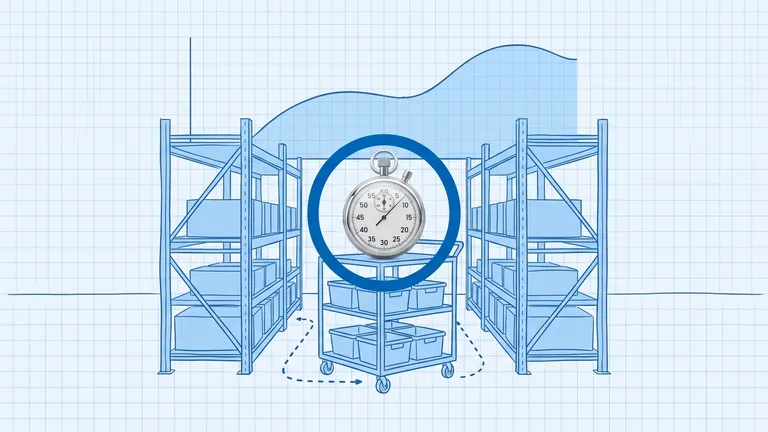
Picking is where most of the labor sits: one widely cited review estimates order picking at as much as 55 percent of warehouse operating expense, and puts roughly half of a picker's time into travel rather than picking. The packing bench is a separate problem, and one most operations never measure, because carriers bill the greater of actual and dimensional weight, so the box a packer reaches for sets a freight cost on every parcel. Shipping is where whatever survived those two steps becomes the customer's problem.
Three steps, three different problems. Picking is where the labor hours go. Packing sets a freight cost on every parcel that most operations never look at. Shipping is where a mistake stops being yours and becomes the customer's. Most advice treats them as one flow to be sped up, but they respond to different fixes, and they are measured in different units, which is why so many warehouses improve one of them and cannot find the improvement in the accounts.
Where does the money actually go?
Picking is the usual answer. In the standard literature review of order picking research, de Koster, Le-Duc and Roodbergen report that "the cost of order picking is estimated to be as much as 55% of the total warehouse operating expense" (ERIM Report Series ERS-2006-005-LIS, January 2006). Two cautions about that number, since it gets quoted everywhere without either. It is an upper bound, not an average, and the review dates from 2006, before most of the e-commerce fulfillment buildout. Treat it as a reason to look at picking first, not as a measurement of your building.
The same review puts travel at roughly half of an order picker's time in a conventional picker-to-parts operation. That is the more useful figure, because it says that about half the picking cost is not being spent on picking. It is being spent walking between picks.
Why is picking the expensive step?
Because travel is paid time that adds nothing to the order. You pay the picker for every step, and the customer pays for none of them.
The standard move is to shorten those steps by slotting: deciding which item lives where, ranked mostly by how often it is picked. It is usually the first thing worth doing, and it deserves two qualifications that slotting business cases tend to leave out.
The first is that the saving is marginal, not absolute. Moving a fast item thirty seconds closer does not save thirty seconds on every order containing it. If the picker was already walking that aisle for another line, the real saving is a fraction of the distance, sometimes close to nothing. Slotting pays most in operations with few lines per order, and least where pickers cross the building anyway.
The second is that reslotting is not free. It means location transfers in the system, relabeling, cycle counts to confirm the moves landed, replenishment minimums and maximums updated, and a stretch of reduced productivity while pickers relearn where things are. It is cheap relative to equipment. It is not "just move some stock."
Velocity is also not the only input. Cube and weight decide what physically fits a pick face, and a fast, bulky item slotted into a small golden-zone location will generate replenishment trips that can cost more labor than the picking it saves. Slot on velocity, then check the answer against size, weight and how often the face will need refilling.
How do you cut pick travel without rebuilding the warehouse?
- Slot the fast movers into the reachable band, subject to the cautions above. NIOSH guidance for manual material handling is direct about the height: keep work "above the knees, below the shoulders, and close to the body", and "avoid manually lifting or lowering loads to or from the floor". A floor-level pick is slower and it is the pick most likely to injure someone.
- Match the picking method to your order profile. Batching cuts the number of trips and pays when orders are short, since one walk serves several orders, with the sort happening afterwards at a put wall or sorting cart. Zoning stops anyone crossing the whole building. Wave picking organizes releases around dispatch times. Lines per order decides which of these helps you; there is no universal order of operations.
- Only then consider automation, and know that goods-to-person and robot-assisted systems change the layout question rather than answering it, because the pick face stops being fixed.
On the ergonomics, know what the numbers actually are. The Revised NIOSH Lifting Equation starts from a load constant of 51 pounds, described by NIOSH as the maximum to be lifted with two hands "under ideal conditions", and reduces it using eight inputs: weight, horizontal distance from the body, vertical height, vertical travel, how far the body twists, frequency, how long the lifting task runs, and the quality of the grip. The result is a recommended weight limit, and NIOSH advises keeping the resulting lifting index at or below 1.0. It is a design tool, not a legal limit. Its practical use on a floor is deciding where heavy items get slotted and where a lift assist or a two-person pick is needed.
What should happen at the packing bench?
Verify, choose a box, produce the paperwork. Verification is the part that must not be skipped, because the bench is the last place an error costs pennies instead of a return. Scanning each unit against the order is the usual control, and on high-count or low-value orders a check weigher at pack is the cheaper version, since it catches shorts and extras without a scan per piece.
Then the box, which is where a cost nobody is tracking gets set.
The box sets a cost most warehouses never measure
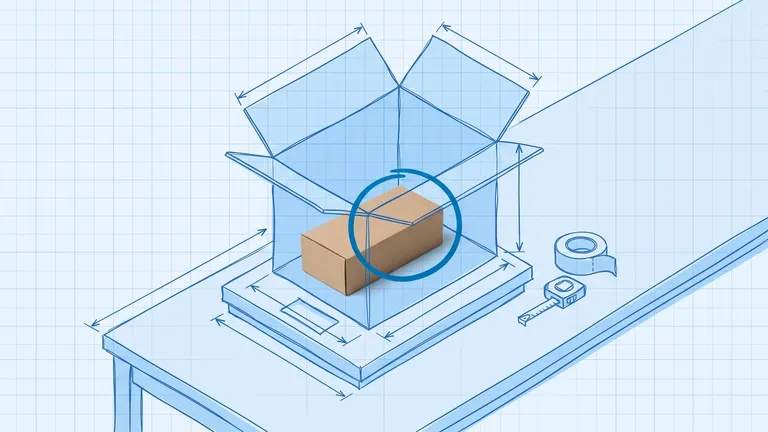
Carriers do not bill on scale weight alone. FedEx puts it plainly: "For each shipment, you are charged based on the dimensional weight or actual weight of the package—whichever is greater", with dimensional weight found by multiplying length by width by height in inches, each measurement rounded to the nearest whole inch, then divided by 139 for US shipments. UPS publishes the same structure with different rounding, giving dimensional weight as length times width times height divided by a divisor, using 139 for daily rates and 166 for retail rates, and increasing any fraction to the next whole pound. Those published divisors are list values; contract rates often differ, so use the divisor in your own agreement.
Put numbers on it, measuring the outside of the carton, which is what the carrier measures. A box that is twelve inches on each outside edge is 1,728 cubic inches. Divided by 139 that is 12.43, billed as 13 pounds, unless the goods weigh more than that, in which case the scale weight wins. The same goods in a box measuring ten inches outside are 1,000 cubic inches, which is 7.19, billed as 8 pounds. Five billable pounds, decided by which box the packer reached for.
Two honest qualifications. Five billable pounds is not five dollars, and parcel rates are not linear in weight, so what it is worth depends entirely on zone and on your discount schedule. And a smaller box is only available if the goods actually fit with enough void fill to survive the trip, so the cheap version of this is not a bigger carton range for its own sake but knowing which box each order should use.
The point is not that packing beats picking. It is that the two are almost never measured in the same unit. Pick performance is tracked everywhere, in seconds and picks per hour. Billable weight against scale weight is tracked almost nowhere, even though it recurs on every parcel and shows up on an invoice you already receive. One of those is easy to price and nobody prices it.
Zone, service level and accessorial charges such as residential delivery, fuel and additional handling still move a parcel bill more than carton size does for most shippers. Carton choice is simply the part of the bill the warehouse controls directly from the bench.
What breaks at the ship step?
Usually the data rather than the parcel, though mis-ships, wrong service levels and short-ships all happen and all cost more than a carton.
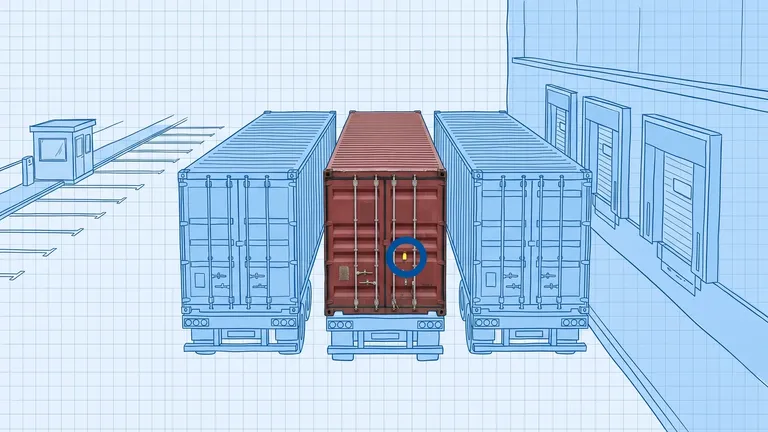
Where goods travel as a logistics unit, the identifier is usually an SSCC. GS1 describes it as a code used "to identify a logistic unit, which can be any combination of trade items packaged together for storage and/or transport purposes; for example a case, pallet or parcel". If a retail customer expects an advance ship notice, the SSCC is the thread tying the physical pallet to the message describing it. A mismatch is a warehouse defect, created at pallet build or at the moment the notice is generated, and it arrives as a chargeback weeks later, which is why it feels like somebody else's problem when it lands.
The control is that nothing gets a label until it has been verified. After the label there is still a window to void it and pull the parcel before the manifest closes, but that window is short and depends on somebody noticing.
How do you know it is working?
Measure in money. Picks per hour is a real signal about labor when hours and headcount are steady, but it will not tell you whether the order got cheaper, because it says nothing about travel, packaging or freight. Track picking hours divided by orders shipped at your loaded rate, the share of parcels billed above scale weight, the error rate caught at verification and the rate that escaped and came back. The warehouse metrics worth tracking are the ones tied to a cost you can act on.
What to do first
Look at your lines per order and pick the method that fits it. Slot the fast movers into the reachable band, then check the answer against replenishment. Then pull one month of carrier invoices and compare billed weight to scale weight. The first two are where the hours are. The third takes an afternoon and is the one nobody has done.
Frequently asked questions
Should I fix slotting or start batching orders first?
It depends on your lines per order. With mostly single-line orders, batch picking and sorting at a put wall is the bigger lever, because one walk can serve many orders. With multi-line orders, slotting matters more, since each order already crosses several locations. Look at your average lines per order before choosing, and be aware that slotting gains shrink if you later move to a goods-to-person or robot-assisted method.
Does dimensional weight apply if my boxes are small?
It applies to every package, but it only changes what you pay when the box is large relative to its contents. Multiply the outside length, width and height in inches, then divide by the divisor in your rate agreement. If the result is higher than the weight on the scale, the carrier bills the higher figure. Dense, well fitted boxes are usually billed on actual weight instead.
How do I tell whether picking or packing is costing me more?
Price both in dollars, because they are measured in different units and cannot be compared otherwise. For picking, divide total picking hours by orders shipped and multiply by your loaded labor rate. For packing, take a month of invoices, find the parcels billed above scale weight, and price the difference on your own rate card. Whichever number is larger is where to start, and it varies by operation.
Plan the route. We deliver the rest.
See how Binlogic powers last-mile logistics — routing, tracking, and the platform that turns the plan into the package on the doorstep.
Book a callback