
















Batch vs Zone vs Wave Picking: Which Fits Your Volume?
Volume is not what decides it. Batch, zone and wave picking are three separate order-picking policy decisions that interact rather than three methods to choose between, so a warehouse is making all three at once whether or not it has named them. What picks the combination is the shape of your orders, how hard your cut-offs are and where you can afford to sort; volume decides how much a change is worth and how large a wave has to be.
Short answer to the question as asked: volume is not what decides it. Volume decides how much a change is worth, and it sizes your waves once you are running them. What decides which of the three to reach for is the shape of your orders, the hardness of your cut-offs, and where you can afford to sort.
The question also carries an assumption: that batch, zone and wave picking are three options on one menu, so choosing one rules the other two out. They are three separate decisions that interact, and you are already making all three whether or not you have named them.
What the three terms mean, and why they are not alternatives
In a widely cited literature review of order picking research, de Koster, Le-Duc and Roodbergen define batching as "the method of grouping a set of orders into a number of sub-sets, each of which can then be retrieved by a single picking tour" (ERIM Report Series ERS-2006-005-LIS, 2006). One walk, several orders.
Zoning splits the building rather than the order list, and the review describes two shapes of it. In progressive zoning one picker starts the order and "the tote and pick list are handed to the next picker" at the zone boundary, so the order travels as a single thing. In "parallel (or synchronised) picking ... a number of order pickers start on the same order" at the same time, each in their own zone, so the order exists in several places at once.
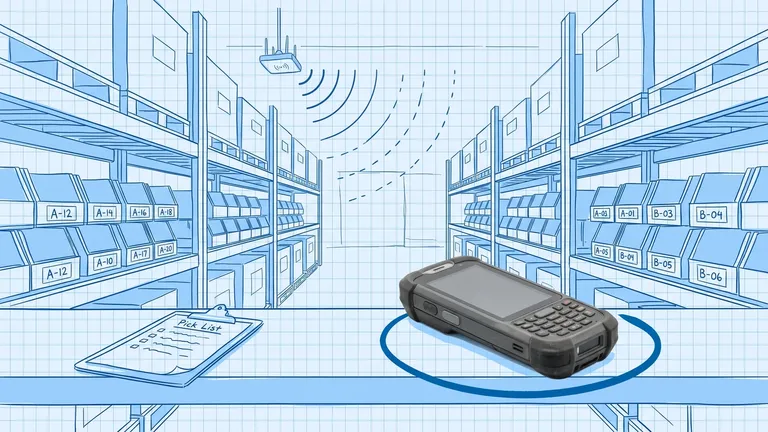
Wave picking is about release, and the review's definition is narrower than common usage: the term "is used if orders for a common destination ... are released simultaneously for picking." A wave is anchored to something leaving the building.
The same review sets out the order-picking policies a warehouse controls as "mainly five factors: routing, storage, batching, zoning and order release mode." Batching, zoning and order release sit beside one another as separate factors, not as three values of one. That is the answer to the comparison: you are not choosing between them but choosing a combination, and the usual ones are unremarkable, being batching within zones, batches inside a wave, or continuous waveless release with batching and zoning on top.
Separable is not the same as independent. Redrawing a zone boundary changes which batches are physically possible. Enlarging a wave changes the pool the batcher has to find affinity in. Sort capacity ties batch size back to zoning. Change one and you usually change what is available on the other two, which is why wave picking is described alongside batching rather than instead of it.
When batching pays, and what it costs
The review states the condition: "When orders are small, there is a potential for reducing travel times by picking a set of orders in a single picking tour," while "when orders are fairly large, each order can be picked individually."
The condition is about the size of an order, not about how many orders leave the building in a day. A warehouse shipping 3,000 single-line orders has far more to gain from batching than one shipping 3,000 orders of fifteen lines each. That is the first reason the phrase "which fits your volume" points at the wrong number.
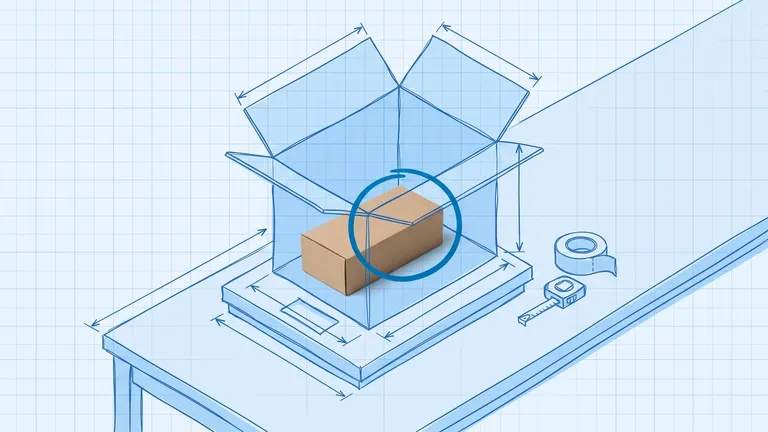
Size here means what fills a cart, so check cube and weight and not only line count. A fifteen-line jewellery order leaves a cart nearly empty; two lines of two heavy totes fill it.
The cost is sorting: if units for several orders travel together, something has to separate them again. The review names the two places you can pay: picking multiple orders "followed by immediate sorting (on the pick cart) by the order picker (sort-while-pick)", or sorting "after the pick process has finished (pick-and-sort)."
Sort-while-pick puts the separation in the picker's hands at the moment of the pick, and it is the cart's cubby count that then limits how many orders ride along. Pick-and-sort keeps the pick fast and creates a second station with its own labor, floor space and queue. Part of what you save in the aisle comes back at the sort. Batching pays when the aisle saving is larger than the sort cost, and a batching project with no plan for the sort has measured only the first half.
What zoning costs you, and which zoning
The review's warning about zoning is widely quoted, usually without the distinction that decides whether it applies to you: "The main disadvantage of zoning is that orders are split and must be consolidated again before shipment to the customer."
That is the parallel case. When several pickers work one order at once, it reaches packing in pieces. Consolidation is real work, it needs somewhere to happen, and it is where orders go wrong, not because units vanish but because three of four pieces are present and the fourth is still upstream.
Progressive zoning is the other trade entirely. The tote moves with the order, so the order arrives complete and there is nothing to consolidate, which is the reason buildings run pick-and-pass in the first place. It pays elsewhere: work sitting in the chain, orders dwelling longer because they wait at each boundary, and the balance problem the review flags, that "the workload must be equally distributed (balanced) over the order pickers." A slow zone in a pick-and-pass line backs work up behind it and starves everyone in front of it, so an imbalance that would be invisible with a single picker becomes the throughput of the whole line.
Zone balance is not set once either. It moves with the season, with promotions and with whatever was last reslotted, which is why zoning and slotting are reviewed together.
What actually sets your waves
One part of a wave is not yours to choose: the cut-off. If a wave is defined by orders sharing a destination, what fixes its end sits at that destination. A trailer that closes, a collection at a set hour, a store delivery that has to be on a particular truck.
Everything else about the wave is yours, and this is where volume earns its place. How many waves, how large, what goes in them, how often you release, and whether short-picked orders are held back are daily decisions, and volume is the first input to all of them. Twelve thousand orders against one cut-off is not one wave. It is several, sized to what pack and sort can absorb.
There is a consequence here that most treatments miss. Batching inside a wave is not the same problem as batching on its own. Gademann, van den Berg and van der Hoff address "the problem of batching orders in a parallel-aisle warehouse, with the objective to minimize the maximum lead time of any of the batches", and state that this is "a typical objective for a wave picking operation" (IIE Transactions 33, 385 to 398, 2001).
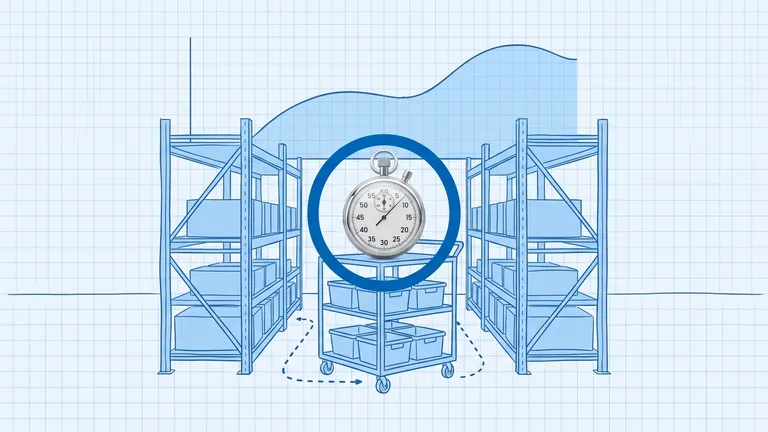
Minimizing the longest batch is a different goal from minimizing total travel. Total travel is a sum; a wave is decided by the last batch to finish, because the vehicle leaves whether or not the final tote made it. Two batching rules can produce near-identical total walking distance and quite different wave completion times. If you run to fixed cut-offs and your system is tuned to reduce total travel, it is optimizing something other than the thing you are judged on.
So what actually decides it
Four questions, in this order.
- What fills a cart on your order profile? Few lines and low cube means batching is the first lever; large or bulky orders already fill a tour and the gain shrinks.
- How hard are your departure times? Fixed cut-offs mean you are running waves whether you call them that or not, and the batching inside them should be tuned to finish the wave, not to minimize total walking.
- Where can you sort? No floor space for a sort station does not settle it: mobile put walls, cart-mounted put-to-light and sorting at the pack bench are all answers. What the space does is bound your batch size, and it is worth knowing that bound first.
- What does a split order cost you at packing? That is the number that decides parallel zoning, and it is worth costing before the decision rather than after it.
Volume belongs on this list as a multiplier, and as the thing that sizes a wave. It is not what picks the method.
Then price it, carefully. The Bureau of Labor Statistics puts median pay for hand laborers and material movers at 18.38 dollars an hour as of May 2025, which is 30.6 cents a minute of base wage. Thirty seconds an order across 400 orders a day is about 61 dollars a day at that rate, and just over 15,000 dollars across 250 working days. Before that goes in a business case, be clear what it is: 833 hours, spread across a whole crew, roughly three and a half hours a day. It turns into cash only if those hours come off the schedule or go to work you were paying for anyway. It is also a national median, and a base wage rather than a loaded one.
What the research says about the software
Gademann and Van de Velde proved that grouping orders into batches so as to minimize total travel time in a parallel-aisle warehouse is "NP-hard in the strong sense", and that it "is solvable in polynomial time if no batch contains more than two orders" (IIE Transactions 37(1), 63 to 75, 2005).
Be precise about what that does and does not say. It is about which orders go together, not how many belong on a cart; batch size is an input to the problem, set by your cart, your sort method and your cube. It is also a worst-case result, so it does not mean a given day's instance is unsolvable; the same paper presents an exact algorithm that solves realistic instances. What it does mean is that no solver will hand you a provably optimal grouping inside a release window, so what any system gives you in practice is a heuristic's answer. Writing in 2005, the same authors observed that "usually simple rules of thumb or straightforward constructive heuristics are used in practice, even in state-of-the-art warehouse management systems."
The conclusion is not that software should be distrusted, but that batching output is something to measure rather than accept, and that a system worth having makes measuring it possible: it should tell you which batching rule is running, let you change it, and report enough for you to compare one rule against another on your own floor.
So keep a baseline before you touch a dial. Picks per hour, wave completion against cut-off and the consolidation queue at packing all come off a standard system. Travel per line usually does not, because it needs location telemetry that most mid-market buildings have never instrumented; picks per hour at a stable cube, or aisle touches per order, is the workable proxy. Change one dial at a time and compare against your own numbers, not a case study from a building you have never seen. If you have not settled on the measures, start from the warehouse KPIs that matter.
Frequently asked questions
Can I use batch picking and zone picking at the same time?
Yes, and the combination is ordinary rather than advanced. Batching decides what gets picked together on one tour; zoning decides whether one picker or several touch an order. A picker can batch several orders within a single zone. What it costs you depends on which zoning you run: parallel zones hand packing a consolidation step that has to be staffed and measured, while pick-and-pass avoids that and pays in order dwell time instead.
Does batch picking always reduce picking cost?
No. The saving comes from sharing one walk across several orders, so it is largest when orders are small and shrinks as an order fills more of the cart. Part of it is then spent again at the sort, either on the cart while picking or at a separate station afterwards. Batching pays when the aisle saving is larger than the sort cost, which is a question about your building rather than a general rule.
How many orders should go in one batch?
Batch size is set by physical limits: what your cart holds by cube and weight, and what your sort method can separate. The research result usually cited here answers a different question: grouping orders optimally to minimize travel is NP-hard in the strong sense, which is why systems use heuristics rather than optima. It does not tell you a cart size. Pick a size the cart and the sort station can carry, then measure against your own baseline.
Plan the route. We deliver the rest.
See how Binlogic powers last-mile logistics — routing, tracking, and the platform that turns the plan into the package on the doorstep.
Book a callback